Why study Computer Science with AI? Explore our new online MSc

Artificial intelligence is changing the skills organisations need from technology professionals.
If you want to develop deeper expertise in computer science and AI without putting your career on hold, our new online MSc Computer Science with a Specialism in Artificial Intelligence (AI), delivered in partnership with Coursera, gives you a flexible way to do it.
The programme is fully online and self-paced, combining core computer science knowledge with specialist learning in artificial intelligence, machine learning, deep learning and neural networks.
You can study wherever you are in the world, continue working while you learn and start in January, May or September.
Why study computer science with AI now?
Demand for professionals with artificial intelligence skills is growing quickly.
Lightcast data shows that global demand for AI skills has increased by 124% year on year, with a median global salary of £103,186 for professionals with AI skills.
The World Economic Forum’s Future of Jobs Report 2025 also identifies AI and big data among the fastest-growing skills in the global workforce. It found that 86% of employers expect AI and information-processing technologies to transform their businesses by 2030.
For working professionals, this raises an important question. How can you build skills that stay useful as individual AI tools and technologies continue to change?
Learning how to use the latest tool can help in the short term. Understanding the computer science, mathematics, algorithms and machine learning principles behind AI gives you a deeper foundation for adapting as the technology develops.
What will you learn on the MSc Computer Science with AI?
The MSc combines a rigorous foundation in computer science with specialist knowledge in AI.
The programme consists of seven core courses, an Industry Specialisation Certificate and a Capstone Project, totalling 180 credits.
You’ll study:
- Programming and Program Design
- Mathematics for Computer Science
- Data Structures and Algorithms
- Artificial Intelligence
- Deep Learning and Neural Networks
- Machine Learning Foundations
- Machine Learning Engineering and MLOps
- Industry Specialisation
- Capstone Project
Together, these areas help you build both theoretical understanding and practical skills.
You’ll develop your programming knowledge and explore how data structures and algorithms can help solve complex computational problems. You’ll study the mathematical principles that underpin computer science and machine learning.
As you progress into the AI specialism, you’ll explore areas including machine learning, natural language processing, autonomous agents, deep learning and neural networks.
You’ll also study machine learning engineering and MLOps, learning about the processes used to move machine learning systems from development into production. This includes data pipelines, cloud platforms, containerisation and continuous integration and deployment, alongside considerations such as security, governance and ethics.
Build practical artificial intelligence and machine learning skills
Learning artificial intelligence is not only about understanding theory. You also need opportunities to apply what you know.
Throughout the programme, you’ll use programming and industry-relevant tools and frameworks to solve problems and evaluate different approaches.
In Machine Learning Foundations, for example, you’ll explore data preparation, feature engineering, model training and performance evaluation. You’ll consider supervised and unsupervised learning and assess factors such as model complexity, scalability and robustness.
In Deep Learning and Neural Networks, you’ll explore how neural networks support technologies such as image recognition and natural language processing. You’ll develop experience designing, training and evaluating deep learning models.
Your Capstone Project gives you the opportunity to bring your learning together through an independent research project focused on a real-world computer science challenge.
Is a master’s in AI worth it?
Short courses and certificates can be useful when you want to learn a particular tool or develop a specific skill, but a master’s degree offers a different level of study.
AI technologies change quickly. Deeper knowledge of computer science, mathematics, algorithms and machine learning can help you understand how technologies work, assess their strengths and limitations and make better technical decisions as the field develops.
An MSc also allows you to connect these areas rather than studying them in isolation.
Your mathematics supports your understanding of machine learning. Programming and algorithms give you the foundations to develop computational solutions. Machine learning leads into deep learning and machine learning engineering. Your Capstone Project then asks you to apply your knowledge to a substantial problem.
For professionals comparing an AI master’s degree online with shorter AI and machine learning courses, that breadth and depth can be an important difference.
Study an online MSc around your career
With Heriot-Watt, returning to university does not have to mean leaving work.
The online MSc Computer Science with a Specialism in Artificial Intelligence is designed to give working professionals flexibility over when and where they study.
The programme is:
- fully online
- self-paced
- available to start in January, May or September
- designed so you can structure your studies around work and other commitments
Each course requires approximately 200 hours of study, including course activities and practice assignments, and is assessed through a Final Online Assessment.
Most students complete the MSc in around three years, although the flexible format allows you to study at a pace that works for your circumstances.
This can give you the opportunity to continue earning while you learn and start applying new knowledge in your professional life as you progress through the programme.
Develop additional industry skills through Coursera
The MSc is delivered in collaboration with Coursera, one of the world’s leading online learning platforms.
As a Heriot-Watt Online student, you’ll also have access to Coursera Career Academy, where you can explore professional certificates from organisations including Google, IBM and Meta.
This gives you another way to develop technical, digital and professional skills alongside your academic studies.
The combination is designed to give you a strong academic foundation while helping you continue developing skills relevant to a changing technology sector.
Can you study the MSc without a traditional computer science degree?
There is an alternative route for applicants who do not meet traditional entry requirements.
We offer a Performance-Based Admission pathway, which gives you the opportunity to demonstrate your ability through your studies rather than relying solely on previous academic qualifications.
To qualify for progression through this pathway, you need to successfully complete the Programming and Program Design course.
This can provide a route into postgraduate computer science study if your experience or previous education does not follow a traditional computer science pathway.
What careers can computer science and AI lead to?
Artificial intelligence skills increasingly sit alongside wider capabilities in programming, software development, data and computing.
The programme is designed for people interested in opportunities across areas including artificial intelligence, machine learning, software development, data analytics and digital transformation.
Potential career paths identified for graduates include:
- Artificial Intelligence Engineer
- Artificial Intelligence Architect
- Algorithm Engineer
- Data Scientist
- Full Stack Developer
For experienced technology professionals, the MSc can help you complement existing industry experience with deeper academic and technical expertise.
If you are changing careers, it can help you build the computer science foundations and specialist AI knowledge needed to move towards technical roles.
Whether you’re looking to progress in your current role, move into a new area of technology or prepare for future opportunities, the programme can help you develop the knowledge and confidence to take your next step.
Why study Computer Science with AI at Heriot-Watt?
Heriot-Watt has a long history in computer science and online learning.
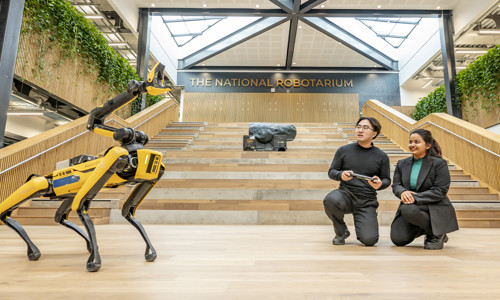
The University was the first in Scotland and among the first in the UK to offer a Computer Science degree. Heriot-Watt is also home to the UK’s National Robotarium, which brings together expertise in robotics, artificial intelligence and advanced computing.
You’ll learn from academics with expertise across research, teaching and industry. The programme is led by Dr Abrar Ullah, who has more than 20 years’ experience across industry and academia.
Heriot-Watt also has more than 30 years’ experience in online education, with programmes designed for a diverse, global community of learners.
Build expertise for an AI-driven future
The tools used in artificial intelligence will continue to change. Professionals who understand the principles behind these tools will be better placed to adapt.
The MSc Computer Science with a Specialism in Artificial Intelligence is designed to help you build that deeper expertise. You’ll develop foundations in computer science alongside specialist knowledge in artificial intelligence, machine learning, deep learning and machine learning engineering.
And because the programme is online and self-paced, you can develop those skills while continuing your career.
Find out how you can start building your expertise in computer science and AI - explore the online MSc Computer Science with a Specialism in Artificial Intelligence.
Related content
Computer Science with a Specialism in Artificial Intelligence (AI)
Earn a globally respected MSc Computer Science online. Gain advanced AI, data and programming skills from a UK leader in computing and robotics.

Computer Science
Earn a globally respected MSc Computer Science online. Gain advanced AI, data and programming skills from a UK leader in computing and robotics.