Heriot-Watt partners with AVEVA and Schneider Electric to explore digital twinning for net zero
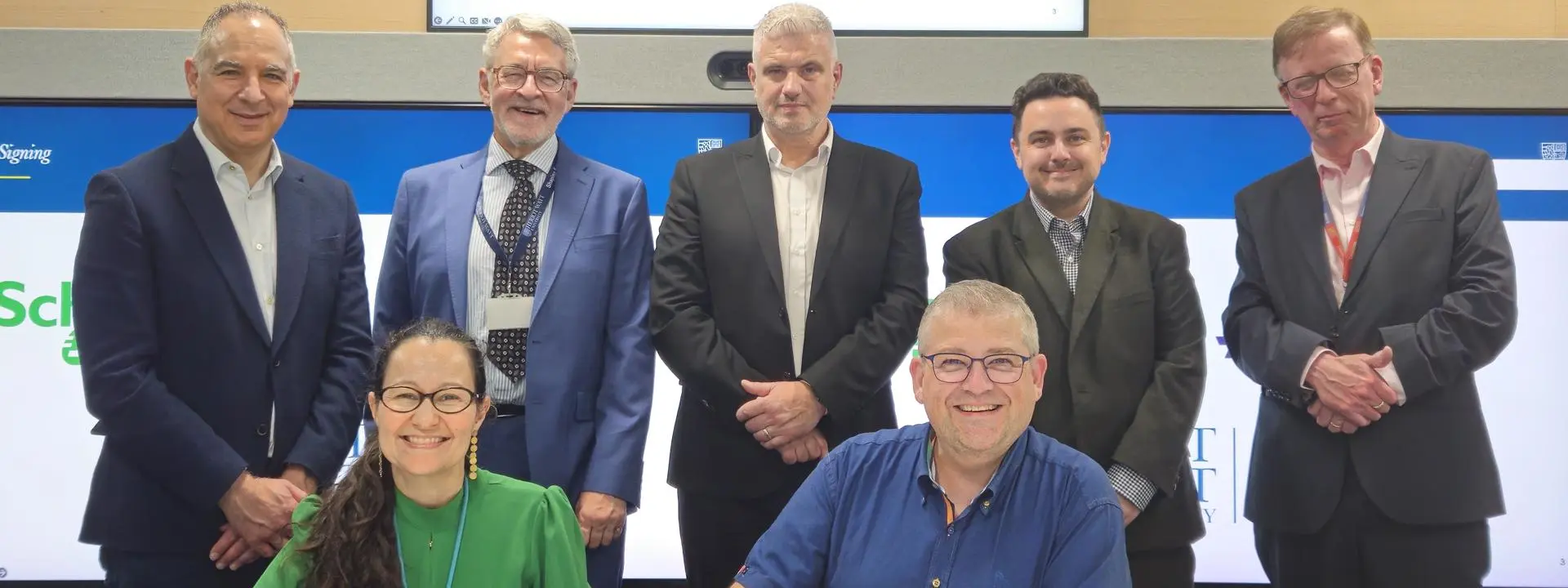
Heriot-Watt University has signed a new Memorandum of Understanding with Schneider Electric UK, acting on behalf of AVEVA Solutions Limited, to explore how digital technologies can support smarter, lower-carbon infrastructure systems across energy and transport.
The collaboration will bring together Heriot-Watt’s research strengths in digital energy systems, transport decarbonisation and sustainable infrastructure with Schneider Electric’s energy management and automation expertise and AVEVA’s industrial software and digital twin capabilities.
Heriot-Watt has a long-standing commitment to working with industry to turn research into practical solutions for society.
Professor Gabriela Medero
Associate Principal for Enterprise at Heriot-Watt University
The work will focus on priority areas including digital twins, smart infrastructure, digital energy systems, transport decarbonisation and sustainable campus operations. It will also create opportunities for closer industry and academic engagement, including potential student projects, internships, research activity and future funding opportunities.
Professor Gabriela Medero, Associate Principal for Enterprise at Heriot-Watt University, said: “Heriot-Watt has a long-standing commitment to working with industry to turn research into practical solutions for society.
“Through iNetZ+ and our wider work in energy and transport decarbonisation, we are focused on helping partners understand and address the complex infrastructure challenges involved in the net zero transition.”
The collaboration will draw on expertise from Heriot-Watt’s Global Research Institute for Net Zero and Beyond, iNetZ+, which brings together researchers and partners to develop practical, scalable solutions for the transition to net zero.
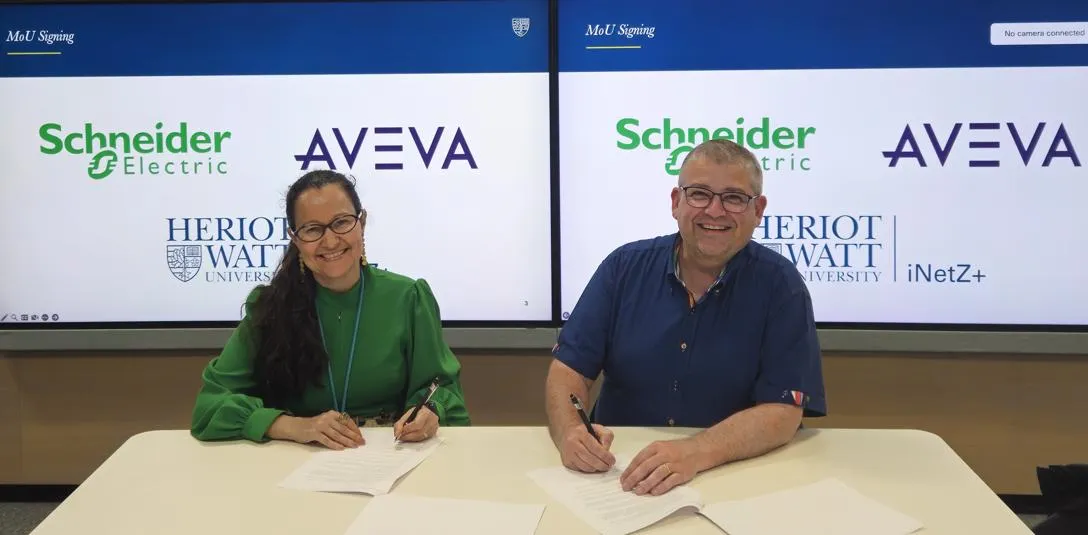
It will support the exploration of digital twin-based optimisation, data-driven decarbonisation and smart energy and transport solutions, using simulation tools and industrial automation technologies in research and demonstration environments.
The partnership also builds on existing collaboration between Heriot-Watt and AVEVA, including research into how digital twin technologies can support real-time monitoring, predictive maintenance, forecasting and operational optimisation for electrolysis systems.
As policymakers and industry look to flexible electrolyser operations to support renewable energy integration and low-carbon hydrogen, digital technologies are expected to play a growing role in helping organisations model, test and optimise complex infrastructure systems before they are deployed at scale.
Lisa Wee, Chief Sustainability Officer at AVEVA, said: “Achieving net zero across energy, industry and transport will depend on closer collaboration between policymakers, academia and industry.
“By harnessing the power of industrial intelligence, and using simulation and digital twins to model organisations with complex systems, leaders can equip their teams to make better decisions and accelerate practical decarbonisation.
“Through this collaboration, we have an opportunity to connect policy ambition, academic research and industrial expertise to support the development of smarter, more sustainable infrastructure.”
David Pownall, VP, Power Systems UK&I at Schneider Electric, said: “The transition to cleaner energy systems requires infrastructure that is not only more sustainable, but also more flexible, efficient and resilient.
“Combining Schneider Electric’s technological expertise in energy management and automation with AVEVA’s industrial software capabilities and Heriot-Watt’s research strengths creates a strong foundation.
“It enables the exploration of practical solutions to optimise energy use across complex environments, from campuses to transport and industrial systems.”
The MoU provides a framework for the three organisations to identify priority areas for collaboration and develop future initiatives across research, innovation, skills and applied technology.
Find out more about Heriot-Watt University’s Global Research Institute for Net Zero and Beyond, iNetZ+, and its work with partners to develop practical solutions for a fair, resilient and low-carbon future.
Contact
Scott Holmes
Related content
New research to improve the safety of autonomous vehicles via better testing simulators
Researchers at Heriot-Watt University are using advanced machine learning to better model human driving behaviour to improve simulators for autonomous vehicle testing.
University signs agreement with Dynamic Earth to inspire next generation of scientists
Heriot-Watt University has signed a Memorandum of Understanding (MOU) with Dynamic Earth.
National Robotarium accelerates industry development of wind farm robotics
New artificial intelligence and control systems could enable underwater robots to operate autonomously, potentially revolutionising offshore wind turbines maintenance.