Godwin Isaac Olubunmi
MSc Sustainable Geoenergy
Godwin, from Nigeria, graduated from MSc Sustainable Geoenergy in 2025. During his time in Heriot-Watt, Godwin was able to travel around the globe to Spain, Yorkshire and Fife to deepen his understandings of energy systems. Godwin reminiscences of the experiences and knowledge gained from Heriot-Watt that shapes who he is today.
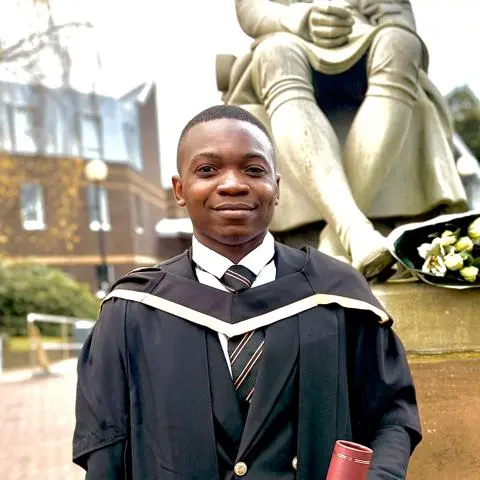
Profile
One of the most demanding yet fulfilling periods of Godwin’s life was his time at Heriot Watt University. From the moment he started his MSc in Sustainable Geoenergy, it has been a journey of endless growth and learning. Looking back, Godwin is deeply grateful for how much it has shaped him. Alongside supportive lecturers that encouraged him to think critically, Godwin was given the opportunity to visit Spain, Yorkshire, and Fife on field trips that brought classroom concepts into real world context and deepened his understanding of energy systems. Beyond academics, Godwin was honoured to serve as Vice President of the Net Zero Society, working with passionate students to promote sustainability and climate awareness on campus. Although demanding, Godwin’s experience at Heriot Watt has been transformative, preparing him for fast paced professional environments and strengthening his passion for contributing to a cleaner and more sustainable energy future.
What programme did you study and why did you choose it?
I studied a Master’s programme in Sustainable Geoenergy. I chose this course because of my strong academic background in petroleum engineering and my long-standing interest in reservoir engineering, which was my favourite aspect of petroleum studies during my undergraduate degree. I have always aspired to become an expert in the subsurface field. After receiving an international scholarship, I began searching for universities in the UK that offered master’s programmes related to reservoir engineering. I discovered that Heriot-Watt University provides a unique Sustainable Geoenergy programme that not only deepens understanding of oil and gas reservoirs but also explores emerging clean and affordable energy sources such as hydrogen, transitional gas, geothermal energy, compressed air energy storage, and carbon sequestration.
As the world moves toward a sustainable energy future, I felt this course would be the perfect fit for me. Coming from a country where sustainability is still developing, I also saw this as an opportunity to gain valuable knowledge that would give me an edge in contributing to a more sustainable energy sector back home in Nigeria.
What were the key differences you found between studying in Nigeria and Scotland?
The key differences I found are mainly in the learning approach, academic environment, and programme structure. In Nigeria, the teaching style is more theoretical, and lecture driven, with a strong emphasis on memorization and examinations. At Heriot Watt, learning is much more research oriented and practical, encouraging critical thinking, teamwork, and independent study. This workload can be more intensive, requiring strong time management and focus, but it also allows students to progress quickly into their careers.
Another key difference is the access to advanced facilities and digital resources. Here, students have exposure to cutting edge technologies, laboratory work, and industry related projects, which make learning more interactive and applicable to real world challenges. Culturally, studying in Scotland has been a rewarding experience. The diversity on campus and the openness of both lecturers and students has helped me grow academically and personally. Overall, the experience has broadened my perspective and strengthened my confidence as an international student.
Can you tell us about the prize you received and how does it feel to be a prize-winning student?
I received the Bruce Blanche Memorial Prize as one of the two winners of this year’s Bruce Blanche Award. The prize is given each year to the student with the best dissertation in geosciences. I felt so excited and proud when I got the news. It means a lot to me because it shows that my hard work and effort were recognized. It has also strengthened my confidence and inspired me to keep learning, growing, and contributing towards sustainable energy solutions in the future.
Did you get any careers support during your time at Heriot-Watt?
I visited the Careers Service to have my resume reviewed, which was helpful in improving how I present my skills and experience. I also attended several career events organized on campus by the Careers Service. These events gave me useful insights into the industry and helped me network with professionals, which was very valuable for my personal and career development.
Can you tell us more about your field trips to Spain, Yorkshire, and Fife?
I had the chance to go on a few memorable field trips that helped me connect what we learn in class to real-world geology. In Fife, we visited the Old Red Sandstone, which is often used as an analogue for reservoirs in things like CO₂ storage, geothermal energy, and oil and gas. It was a great way to see and study rock properties like porosity and permeability in a natural setting.
At the North Yorkshire Coast, we explored mudstone-dominated cliffs that are like cap-rocks used in Carbon Capture and Storage (CCS) projects. We got to apply geomechanical concepts to real formations, identify structural features, and even work in groups to give presentations on how we would approach a CCS project based on our observations. It was hands-on and made the concepts we study feel very real.
In Spain, we visited the Southern Pyrenean and Ebro Foreland Basins. The focus was on understanding sand bodies and reservoirs at outcrop level. We did practical exercises, presentations, and even a seismic interpretation task using synthetic data, which was a great way to link what we see on the surface to what might be happening in the subsurface.
Can you tell us more about your experience as Vice President of the Net Zero Society?
I served as Vice President of the Net Zero Society for four months. During this time, I was involved in projects and events aimed at promoting sustainability on campus and beyond. We organized awareness campaigns, workshops, and collaborations with internal and external organizations to encourage recycling, waste reduction, and lowering carbon emissions.
One of the most memorable experiences was visiting the Scottish Power Company wind farm. It was inspiring to see renewable energy in action and to learn first-hand how large-scale wind energy contributes to Scotland’s net zero goals. Experiences like these deepened my understanding of sustainable energy systems and motivated me to continue advocating for practical climate solutions. Even in a short period, being part of the society allowed me to develop leadership, teamwork, and communication skills while contributing to initiatives that made a real difference on campus.
How has the University aided your professional and personal development?
I’ve had the chance to gain hands-on experience with industry simulation software, which is great for analysing energy systems and reducing uncertainties in real projects. At the same time, group projects, presentations, and opportunities, like being part of the Net Zero Society, have helped me build my confidence, teamwork, and leadership skills. Altogether, my time here has prepared me well for a career in the energy sector while helping me grow as a person.
What are you planning to do after you graduate?
After I graduate, I plan to pursue a career in the energy sector, focusing on subsurface energy systems and sustainable solutions. I want to apply the skills and knowledge I’ve gained during my master’s, particularly in areas like reservoir engineering, carbon capture, and renewable energy, to help develop cleaner and more efficient energy projects. My goal is to contribute to the energy transition while continuing to learn and grow as a professional in the field.