Anna-Marie Mundt
MSc Logistics and Supply Chain Management
Anna-Marie, from Germany, graduated from MSc Logistics and Supply Chain Management with a Distinction in 2025. Interested in pursuing a career in supply chain management, Anna-Marie looked to Heriot-Watt to provide her with invaluable experience and support, such as industry visits, a collaborative dissertation and consultations from Careers.
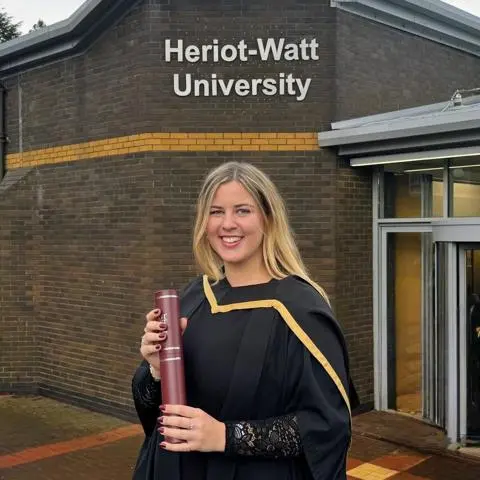
Profile
For Anna-Marie, moving to Edinburgh from Germany to study for a MSc in Logistics and Supply Chain Management was both exciting and challenging. As an international student and the first in her family to attend University, adapting to a new country and academic system meant stepping out of her comfort zone.
Her first few weeks at Heriot-Watt were full of new routines, lectures, and finding her place, but gradually, Edinburgh began to feel like home.
Over the course of her programme, Anna-Marie was able to pursue her passion for sustainability, including working on her dissertation with a notable Scottish charity operating within the circular economy.
Discover more about Anna-Marie’s journey at Heriot Watt below.
What programme did you study and why did you choose it?
I completed the MSc in Logistics and Supply Chain Management. After my Bachelor’s degree in International Business and Management, I wanted to specialise further and build a deeper understanding of how organisations create value through integrated operations. As I’m interested in how supply chains can be designed to be both efficient and environmentally responsible, it offered the right mix of strategic insight and practical tools to build deeper expertise in this field. So, gaining comprehensive knowledge of logistics and supply chain management felt like the natural next step.
What were the key differences you found between studying in Germany and Scotland?
The structure and learning culture are quite different. In Germany, the semester is six months long and more exam-oriented. In Scotland, I experienced more continuous assessments, which encouraged ongoing engagement with the material and more independent research throughout the semester.
I also noticed more group work in Scotland, while in Germany most tasks are individually based. Another difference was the academic rhythm: in Scotland, I had genuine time off over Christmas and New Year, whereas in Germany, I usually had to study during that period to prepare for exams immediately afterward.
Can you tell us about the prize you received and how it feels to be a prize-winning student?
I feel genuinely honoured to have received a Distinction award. It’s rewarding to see that the hard work invested throughout the year has been recognised. The experience of the programme itself already felt like an achievement and the prize is a meaningful and motivating addition.
Can you tell us more about your dissertation work with a Scottish charity?
My dissertation was carried out in collaboration with The Big House Multibank, a charity organisation operating within the circular economy by using reuse and reverse-logistics principles to support families in areas with high levels of deprivation. The project focused on identifying the most suitable location for a new Multibank on Scotland’s west coast to maximise sustainable social impact. I developed a decision-making framework based on location factors relevant to their operations and mission.
I applied for it after discovering the opportunity for dissertation partnerships and together with the University, we shaped the research, so it aligned with my practical goals and academic requirements.
I visited the organisation’s site in Fife to observe operations first-hand, including the warehouse set-up and conducted in-person interviews with their team and key stakeholders. Their willingness to share insights and use their network provided a strong foundation for the research. It was a niche and highly rewarding topic that allowed me to connect theory with practice while contributing to a sustainable impact.
Can you tell us about any support you received as a student?
I felt well supported throughout my studies. The Careers Service offered valuable guidance and the program leader was approachable, constructive and genuinely invested in student progress. The University provides extensive support options, and I appreciated knowing that help was available whenever needed.
What advice do you have for current students?
I found it important to engage actively in classes from the start by asking questions and building my understanding. Consistency in my work throughout the semester made a big difference.
Make use of the academic support available, such as writing resources, skills workshops and opportunities to receive feedback from tutors and professors. Studying with peers was also effective as it enabled us to learn from each other and stay motivated. At the same time, I learnt the value of maintaining a healthy balance, like meeting friends in the library to study and then taking breaks afterwards, which worked particularly well for me. Also, incorporating sports was also key to building resilience during more demanding periods.
What are you planning to do after you graduate?
I am interested in developing sustainable logistics strategies and optimising warehousing operations, aiming to contribute to more responsible and future-oriented supply chain solutions.