Aishwarya Gajendran
MSc Economics, Banking and Finance
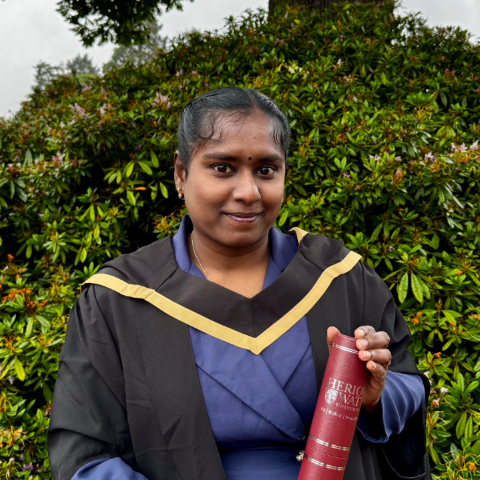
Aishwarya, from India, graduated from the MSc Economics, Banking and Finance programme in 2026. Being a first generation student, Aishwarya was navigating a new world while battling with the pressure of being her family's hope for a better future. Today, Aishwarya continues to thrive and give back to those once in the same position as her.
Profile
Being the first person in her family to pursue higher education, Aishwarya’s journey from India to Scotland has been shaped by resilience, purpose, and a deep belief in the transformative power of learning. Studying an MSc in Economics, Finance and Banking became a personal journey of growth, with navigating a new country, adapting to a different academic culture, and carrying forward the dreams of her family.
From overcoming personal loss to discovering new perspectives through fieldwork and supportive mentors, Aishwarya’s time in Scotland has strengthened her commitment to using education as a tool for dignity, opportunity, and social change.
What programme did you study and why did you choose it?
I studied an MSc in Economics, Finance and Banking. I chose this programme because of the unique interdisciplinary course structure offered by the School of Social Sciences and Edinburgh Business School. The programme combined economics, finance, and banking, which matched my academic interests and career goals. I also wanted to pursue a PhD in Economics, and I believed that completing a master’s degree in the UK would strengthen my academic training, improve my research skills, and provide a strong pathway towards doctoral studies.
What were the key differences you found between studying in your home country of India and Scotland?
One of the key differences I found between studying in India and Scotland was the learning approach. While around 90% of my course structure still involved written examinations similar to those in India, the overall academic environment in Scotland was more application-based. Classrooms encouraged open discussions, critical thinking, and independent learning rather than purely theoretical study.
In addition to the academic differences, adapting to life in Scotland was personally challenging. Living away from my family, managing expenses independently, and adjusting to the weather conditions affected my studies. However, these experiences gradually helped me become more independent and confident.
What does it mean to you to be the first person in your family to pursue higher education? Being the first person in my family to pursue higher education means carrying the dreams and struggles of generations before me. I still remember going to school and seeing my father work on the streets carrying bricks and cement so that my brother and I could study and have a better future. From that life, to becoming a first-generation graduate and studying at the Edinburgh Business School, feels surreal to me.
This is my second master’s degree. During my first master’s, my father was bravely fighting cancer. Those were some of the hardest days of my life, but I did not have the privilege to stop studying because education was our only hope and our only tool for liberation. Even in his final days, my father’s last words to me were to continue studying and write my exams, which were scheduled just days after his passing. Graduating with his surname, Gajendran, is something that makes me emotional because I feel I have made him proud.
Being a first-generation learner also means understanding how unequal access to education can be. Many students from villages and working-class backgrounds have the talent and determination to succeed, but opportunities to study abroad are often limited to those with social and financial privilege.
I would also like to acknowledge the influence of my ideological teachers, B. R. Ambedkar and Periyar E. V. Ramasamy, whose ideas taught me that education is a path to dignity, self-respect, and social transformation. I hope to see a future where students from every part of the world, especially first-generation learners from villages and marginalized communities, are given equal opportunities to pursue higher education and study abroad without barriers.
What’s your most memorable moment from your time as a Heriot-Watt student?
My most memorable experience as a Heriot-Watt student was working on my dissertation, which involved two months of fieldwork travelling across the coastal villages of East and North Scotland. During this time, I had the opportunity to meet and interact with hundreds of fishermen and members of coastal communities. Listening to their experiences and understanding the fishing heritage, livelihoods, and everyday struggles of Scotland’s coastal communities gave me a much deeper appreciation of the relationship between economy, environment, and culture. It was one of the most meaningful learning experiences I have ever had because it took learning beyond classrooms and allowed me to connect directly with people and their lived realities.
Another highlight of my time at Heriot-Watt has been the unconventional and highly interactive Development Economics classes taught by Philippe LeMay-Boucher. His teaching style encouraged discussion, critical thinking, and deeper engagement with real-world economic issues.
Can you tell us about the support you received as a student?
One of the biggest sources of support during my studies was my student counsellor, who was extremely kind and understanding throughout my academic journey. Adjusting to a new country and managing the pressures of postgraduate study was not always easy, and having someone who listened and guided me made a significant difference. The supportive environment at Heriot-Watt helped me feel less isolated and more confident in continuing my studies.
I joined the University only a few months after the passing of my father, so it was an emotionally difficult period in my life. Although I was still processing grief, the University environment, especially the understanding shown by staff and support services, helped me gradually adjust to student life again. Being able to continue my education during such a difficult time gave me a sense of purpose and strength.
What advice do you have for current students?
Throughout most of my academic journey, I considered myself an average student and often struggled with self-doubt and anxiety about my abilities. My advice to current students is to believe in yourself and trust the process of consistent learning and perseverance. You do not need to be perfect to succeed. Small efforts made consistently over time can help overcome even the biggest barriers.
I would also encourage students to seek help from professors or classmates when they have doubts about subjects. Asking questions is part of learning, and reaching out for guidance can make a huge difference both academically and personally.
What are you planning to do after you graduate?
After graduation, I plan to pursue a PhD in Economic Geography, focusing on issues related to environment, development, and inequality. I also hope to build a career in the field of environmental economics, where I can contribute to research and policy discussions on climate change, sustainability, and vulnerable communities.