Key information
Find out more about our 3 year honours degree option.
- UCAS code
- 3K3W
- Level
- Undergraduate
- Delivery type
- Full Time
- Degree qualification
- MA
- Mode of delivery
- On-Campus
- Duration
- 3-4 years
- Location
- Edinburgh
- Start date
- September
MA (Hons) Geography, Society and Environment will interest you if you want to specialise in human geography and related topics such as urban design, social policy and equity, sustainable cities, and sustainable development. Overall, this degree explores the ways in which people shape and are shaped by the places and environments in which they live.
You’ll consider questions such as:
-
How do cities change and how do the people involved shape those cities and neighbourhoods?
-
How does the built environment shape our behaviour?
-
What makes some places healthier or happier or more resilient?
Our industry links and cross-disciplinary learning style ensures our teaching is relevant in the real world, and you’ll experience what it is like to be a professional geographer working in practice. Throughout your studies, you’ll hear from guest practitioners from industry to gain insight into current approaches to solving challenges.
You’ll be taught through courses relevant to 21st century global challenges on topics such as aging populations, social inequalities, nature-based solutions and sustainable development, and you’ll gain employability skills such as digital mapping through geographical information systems and collaborative group working.
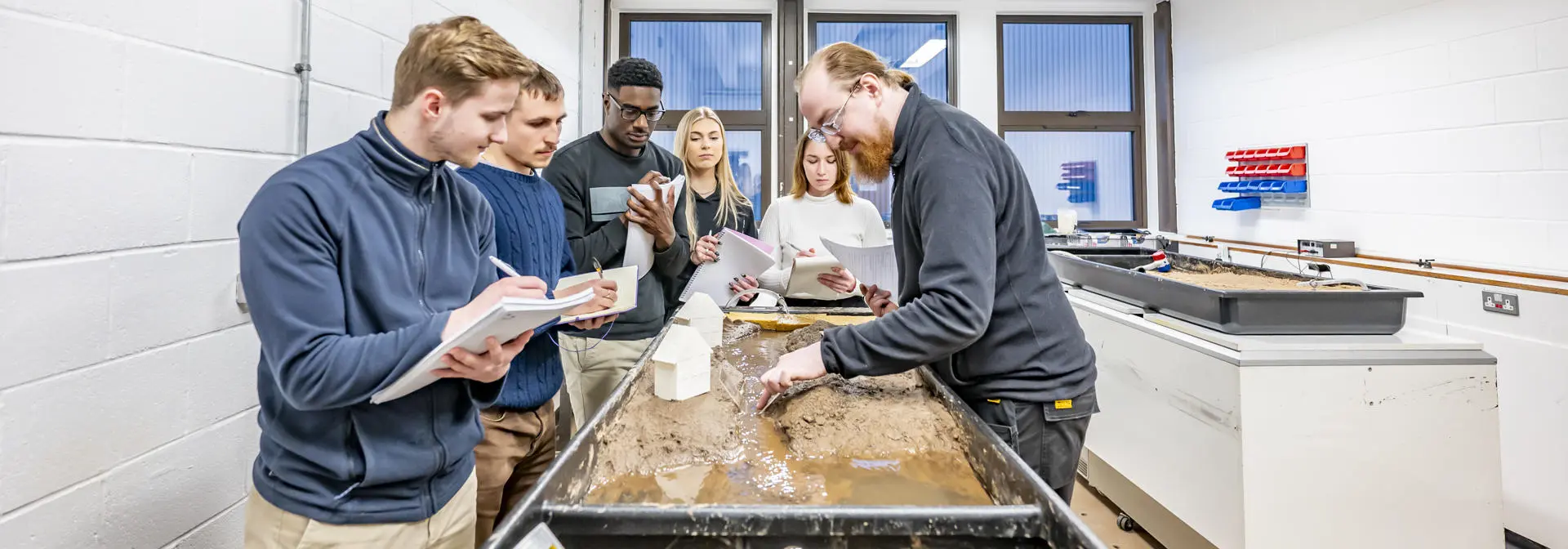
In years one and two, you’ll cover a broad range of fundamental courses on human geography (social, economic, and urban), physical geography (earth systems, hydrology, and geomorphology), transferable and geography-specific skills and practical fieldwork. You’ll specialise in human geography in the later years of the degree, studying cities, place and place making, and urban development.
You will develop field skills in surveying, mapping, and questionnaires, alongside important analytical and research skills. Through this cross-disciplinary, industry focussed, and problem-based degree, you’ll acquire the skills needed to work in multi-disciplinary teams and solve real-world problems. You’ll become flexible and creative with the ability to apply your skills and knowledge to a range of careers.
Your student experience
Your learning will be informed by the expertise of our research-active geographers and academics from The Urban Institute which sits within the School of Energy, Geoscience, Infrastructure and Society (EGIS).
EGIS is one of the United Kingdom’s leading institutions for multidisciplinary research and teaching in areas critical to economic development and societal equity. Our teams work closely and have links with industry, and practitioners are regularly invited as guest lecturers in most courses and advise on student research projects.
Course content
September Intake - Edinburgh
Mandatory September
- Geography Today
- Dynamic Earth 1
- Introduction to Human Geography
- Shaping Tomorrow Together A
Mandatory January
- Dynamic Earth 2
- Scottish Geographies: Fieldwork Observation
- Human Geography & The City
- Shaping Tomorrow Together B
Disclaimer
The courses mentioned above may change between now and the time that you study. For more information, please view our Terms and Conditions.
Programme Video
How to watch this YouTube video
We couldn't detect your cookie choices so can't show this video here. You can watch on YouTube below.
Student testimonials
See moreI studied Physical Geography as I have always enjoyed a more natural setting and learning about the many natural processes across our globe. I chose this degree to lean more into biodiversity specifically and how this can be protected alongside our ever-growing societies. I originally chose to study at Heriot-Watt for its surroundings, as the campus is so beautiful. But after four years, the Sports Union and other student communities became a huge part of my life. Volunteering and helping others engage with the many facilities was something I became very passionate about.

Fees and funding
| Status | Fee |
|---|---|
| Scotland | Paid by SAAS |
| England / Wales / N Ireland / Rep of Ireland | £10,050 |
| International | £22,040 |
- Status: Your residency status is usually defined as the country where you have been ordinarily resident for the three years before the start of your course.
- International: 'International' includes applicants from European Union countries who do not hold Pre-Settled or Settled status in UK. (This does not include students from the Republic of Ireland - see above).
Scholarships and bursaries
Bursaries for students from England, Northern Ireland or Wales
In addition to government loans and grants towards the costs of fees and living costs, we are offering generous financial support to attract and support eligible undergraduate students from England, Northern Ireland or Wales:
- Heriot-Watt University Bursary (up to £3,100 per year)
Entry requirements
If joining us in September 2027, please see the entry requirements below. Heriot-Watt offers different entry requirements, depending on your background.
Standard entry requirements
- Highers AABB (over two sittings).
- A-Levels BBC.
- International Baccalaureate 29 points.
- BTEC Extended Diploma DMM.
- HNC B in graded unit.
Please check that you meet our University-wide National 5/GCSE (or equivalent) English and Maths requirements.
Minimum entry requirements *
- Highers BBBC (over two sittings).
- A-Levels BCC.
- International Baccalaureate 29 points.
- BTEC Extended Diploma DMM.
- HNC B in graded unit.
* Minimum: under our Fair Access Policy, we will relax our standard entry requirements for some Scottish and Rest of UK status students depending on their circumstances. Our minimum requirements will apply if you:
- live in an area within the Scottish Index of Multiple Deprivation lowest 20% (SIMD20) or POLAR4 Quintile 1 regions (RUK)
- or are care experienced.
We can also make exceptions for some Scottish students with grades above minimum but below standard. Read more about our Minimum and standard entry requirements.
Why Heriot-Watt
We have been producing career-ready graduates since 1821. With our roots as the world’s first Mechanics Institute, Heriot-Watt is a pioneering university with a global reach.
At Heriot-Watt, learning goes beyond the lecture theatre. We tackle real world challenges through extraordinary research – from climate change to protecting our oceans, to advancing life-saving medical breakthroughs and shaping the next generation of AI. We are also committed to developing forward-thinking design and sustainable business practices that impact industries worldwide. On our campuses you’ll find some of the world’s most advanced facilities, while our strong industry links set you up for career success. This is why almost 90% of our graduates are in employment or further education (Graduate Outcomes Survey 2024).
Employability
Potential career paths
- Conservation and environment professionals
Student life
Explore facilities, and chat to staff and students


Discover Uni course data
Discover Uni provides data on each university's degree courses across a range of measures including student satisfaction, graduate jobs and salaries.