Key information
MSc Biomedical Engineering (jointly delivered with the University of Edinburgh) is an interdisciplinary master's programme that combines engineering, medical technology, biosensing, biofabrication, and medical device design to develop advanced skills for innovation in healthcare and biomedical industries.
- Level
- Postgraduate Taught
- Delivery type
- Full Time
- Degree qualification
- MSc
- Mode of delivery
- On-Campus
- Duration
- 1 year
- Location
- Edinburgh
- Start date
- September
Our MSc in Biomedical Engineering introduce you to engineering technologies and applications within the biomedical industry and provide you with knowledge of medical technologies and their application, with a focus on integrated medical devices, design and manufacture skills, and an understanding and practice of key concepts in biosensing and biofabrication.
This programme is aimed at graduates or those already in the industry who want to build on their engineering and physical science knowledge to build a unique competence in the fields of applied biomedical engineering.
The masters programme is taught through a collaboration between Heriot-Watt University and the University of Edinburgh, offering you a bespoke learning experience at the forefront of the discipline, and the opportunity to expand both your knowledge and your networks.
Reasons to study:
- Industry-relevant curriculum: Demonstration of skills and knowledge learnt by applying design, manufacture and characterisation techniques to develop new insights and responses to current issues in biomedical engineering in the final year dissertation.
- Comprehensive, customisable curriculum: Provides opportunity to focus on areas of either bioelectronic or biomedical manufacturing with optional courses, allowing students to customise their expectations and outcome from this programme.
- Expert faculty: Learn from research-active biologists, engineers and physicists in the School of Engineering and Physical Sciences at Heriot-Watt University and the School of Engineering at the University of Edinburgh.
- Leaders in research: World class research carried out by Heriot-Watt’s Global Research Institute in Health and Care Engineering, and several other research institutes including the Institute of Biochemistry, Biophysics and Bioengineering (IB3) and the Institute for Mechanical, Process and Energy Engineering (IMPEE), focuses on promoting biomedical engineering, digital engineering, energy harvesting & conversion, and multiphase flow.
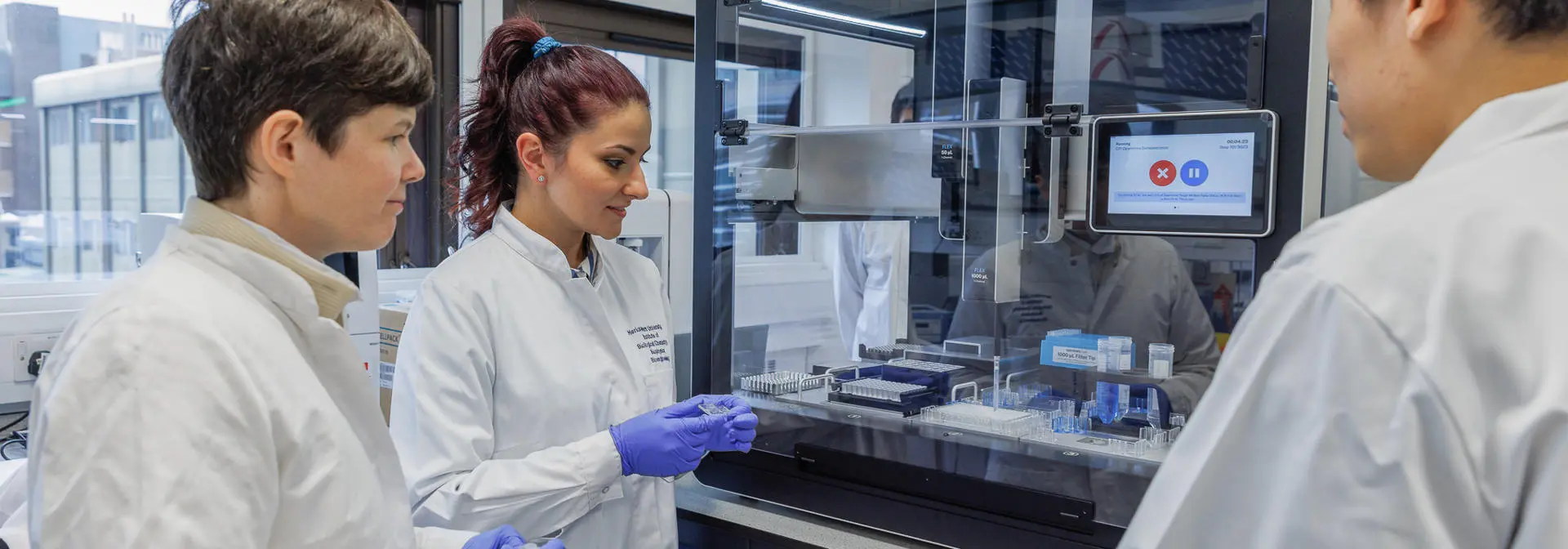
- Supported learning: Delivered through a combination of lectures, tutorials, practicals, lab visits, guest lectures, group projects and self-learning and be assessed by coursework, exams, and your dissertation while receiving support and feedback throughout the programme. Gain access to specialist equipment, software and laboratories at both Heriot-Watt University and University of Edinburgh.
Your student experience
Your learning will be informed by the expertise of the research-active biologists, engineers and physicists in the School of Engineering and Physical Sciences at Heriot-Watt University and the School of Engineering at the University of Edinburgh.
The School of Engineering and Physical Sciences is renowned for its world-class research into the areas of biomedical engineering, with expertise in manufacturing evidenced by the Medical Device Manufacturing Centre (MDMC), the National Robotarium, and the Queen’s Anniversary Prize in Photonics.
In a joint submission with the University of Edinburgh, 96% of Heriot-Watt University’s engineering research was classed as world-leading in the REF 2021 review, which ranked us 1st in Scotland and 3rd in the UK for engineering research.
Our joint MSc Biomedical Engineering is directly informed by the world class research carried out by Heriot-Watt’s Global Research Institute in Health and Care Engineering, and several other research institutes including the Institute of Biochemistry, Biophysics and Bioengineering (IB3) and the Institute for Mechanical, Process and Energy Engineering (IMPEE) which focuses on promoting excellence in themes such as
-
Biomedical Engineering
-
Digital Engineering
-
Energy Harvesting and Conversion
-
Multiphase Flow
The research relevance of this postgraduate programme ensures your studies remain innovative and industry focused.
Course content
September Intake - Edinburgh
Mandatory September
- The Engineering-Biology Interface
- Manufacture in Bioengineering
Mandatory AY
- Multidisciplinary Biomedical Engineering Group Design Project
Mandatory January
- Technology Entrepreneurship 5 (University of Edinburgh)
- Critical Analysis and Research Preparation
Optional September
- Bioelectronics (University of Edinburgh)
- Technologies for Biosystems
Optional January
- Sensors and Instrumentation (University of Edinburgh)
- Biomaterials
- Lab-on-Chip Technologies (University of Edinburgh)
- Regulation of the Safe and Sustainable Development of Substances
Mandatory May
- Masters Dissertation
Disclaimer
The courses mentioned above may change between now and the time that you study. For more information, please view our Terms and Conditions.
Programme Video
How to watch this YouTube video
We couldn't detect your cookie choices so can't show this video here. You can watch on YouTube below.
How to watch this YouTube video
We couldn't detect your cookie choices so can't show this video here. You can watch on YouTube below.
Fees and funding
| Status | Full Time |
|---|---|
| UK | £16,800 |
| International | £41,160 |
- Status: Your residency status is usually defined as the country where you have been ordinarily resident for the three years before the start of your course.
- International: 'International' includes applicants from European Union countries who do not hold Pre-Settled or Settled status in UK. (This does not include students from the Republic of Ireland - see above).
Scholarships and bursaries
Alumni Discount 10% - MSc Biomedical Engineering
Please note the MSc Biomedical Engineering is exempt from our usual alumni discount. Instead, all Heriot-Watt and University of Edinburgh Alumni applying for this MSc will receive a 10% discount as part of your offer.
We aim to encourage well-qualified, ambitious students to study with us and we offer a wide variety of scholarships and bursaries to achieve this. Over £6 million worth of opportunities are available in fee and stipend scholarships, and more than 400 students benefit from this support.
Entry requirements
We have standard entry requirements for all of our courses that you will have to meet.
For MSc entry, a good relevant Honours degree (first or upper second class) or equivalent overseas qualifications will be considered. Areas such as Engineering, Physics and Biotechnology (or similar) will be core disciplines. Given the clear practical element of the programmes, we will also consider non-graduate candidates holding less than a good Honours degree, or its equivalent, but with compensating qualifications or experience may be admitted.
We welcome applications from international students and accept qualifications from around the world. Please refer to the entry requirements for your country for more details.
Why Heriot-Watt
We have been producing career-ready graduates since 1821. With our roots as the world’s first Mechanics Institute, Heriot-Watt is a pioneering university with a global reach.
At Heriot-Watt, learning goes beyond the lecture theatre. We tackle real world challenges through extraordinary research – from climate change to protecting our oceans, to advancing life-saving medical breakthroughs and shaping the next generation of AI. We are also committed to developing forward-thinking design and sustainable business practices that impact industries worldwide. On our campuses you’ll find some of the world’s most advanced facilities, while our strong industry links set you up for career success. This is why almost 90% of our graduates are in employment or further education (Graduate Outcomes Survey 2024).
Student life
Explore facilities, and chat to staff and students