Driving research forward through simulation and testing
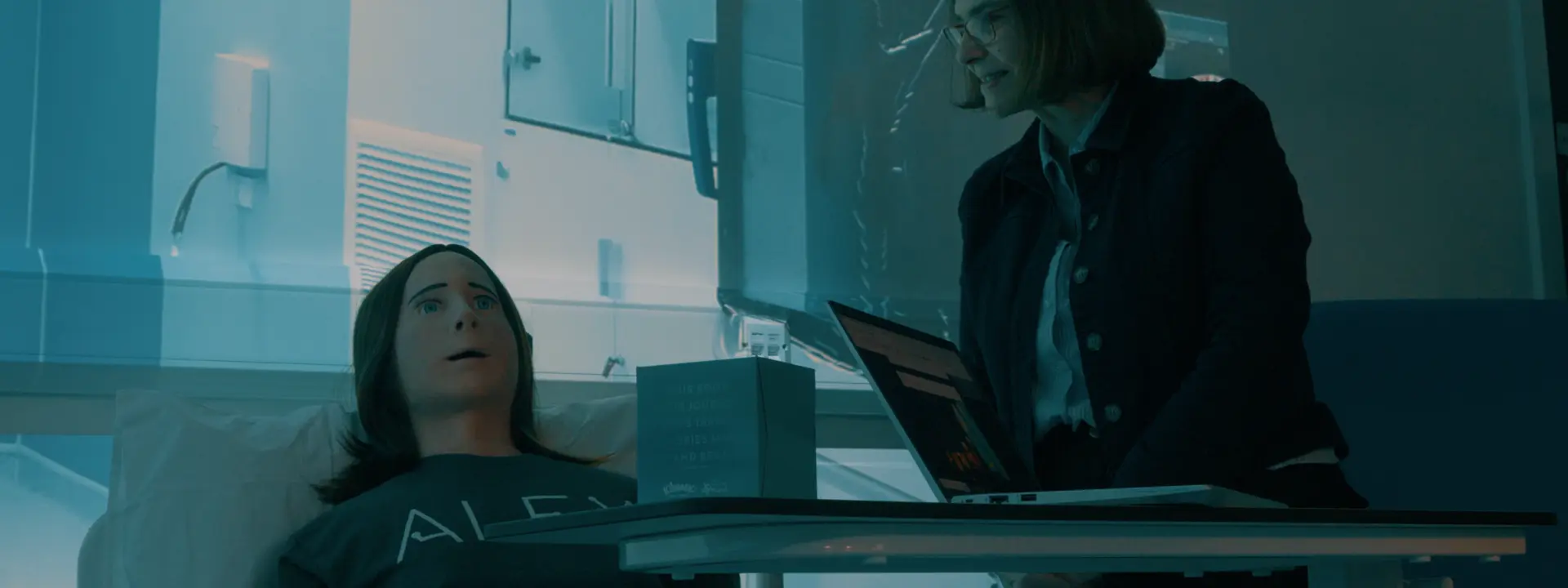
Turning a promising research idea into a reliable, real-world health technology often depends on access to the right environment as much as the right expertise. For Professor Dimitris Anagnostou, the Immersive Suite at Heriot-Watt University has played a critical role in progressing VisionRF, an innovative remote monitoring device designed to detect respiration and heart rate without the need for wearable sensors or physical contact.
VisionRF addresses a growing challenge in healthcare settings: how to monitor vital signs accurately and continuously, particularly in environments where wearable devices are impractical, intrusive or potentially unsafe. By enabling the remote detection of physiological signals, VisionRF opens new possibilities for monitoring patients in hospitals, care facilities and high-risk settings, including custodial environments.
From concept to controlled validation
A key stage in the development of any medical monitoring technology is validation, — proving that it can deliver accurate and reliable measurements under controlled conditions before moving into more complex real-world scenarios. The Immersive Suite provided VisionRF with exactly that capability.
Central to this work was the use of ALEX, a highly advanced medical manikin housed within the Immersive Suite. ALEX’s physiological parameters, including heart rate, can be precisely configured and held constant. This allowed Professor Anagnostou and his team to assess the accuracy of VisionRF’s heart rate detection in a tightly controlled environment, removing variables that would otherwise complicate early-stage testing.
The stationary nature of the ALEX manikin was particularly advantageous. VisionRF’s monitoring equipment performs optimally when patient movement is minimal, a common condition in many clinical and observational settings. By using ALEX, the research team could replicate these conditions consistently, ensuring that test results were robust, repeatable and suitable for informing further development.
“The Immersive Suite was instrumental in accelerating VisionRF from a laboratory prototype to a credible, real-world solution.” said Professor Dimitris Anagnostou
A flexible environment for translational research
“Designed to simulate a wide range of real-world settings, the Immersive Suite offers fully customisable environments that can be rapidly adapted to support research, engagement and knowledge exchange activities. These environments include hospital rooms, care homes, custodial settings, GP surgeries, pharmacies and domestic spaces, enabling researchers to test and present innovations within realistic and relevant contexts.” Isadora Myst, Immersive Suite Specialist
The adaptability of the Immersive Suite proved particularly valuable as VisionRF entered a new phase of development focused on communicating its real-world application to external audiences. As part of Converge, Scotland's springboard for university founders, the VisionRF team developed a high-quality pitch video that clearly demonstrated the environments in which the technology could be deployed.
For this purpose, the Immersive Suite was configured to replicate a prison cell, reflecting VisionRF’s potential use in custodial settings, particularly for individuals on suicide watch. Monitoring vulnerable individuals in such environments presents specific challenges, including the need to minimise the use of wearable or physical devices that could be tampered with or pose additional risk.
By recreating this setting within the Immersive Suite, the team were able to produce a pitch that was grounded in realism and societal relevance, rather than abstract explanation. This enabled judges and stakeholders to clearly visualise both how the technology functions in practice and the meaningful impact it could deliver in high-risk care environments.
Professor Dimitris Anagnostou stated
“By enabling realistic, high-fidelity simulations of prison and care environments, the Immersive Suite allowed us to engage stakeholders early, test usability and ethics in context, and refine both the technology and its value proposition far more rapidly than traditional lab or real use-case settings would allow. This has helped attract significant amounts of funding during recent years and directly strengthened our research translation and commercial readiness.”
Supporting reflection, learning and iteration
Another key benefit of the Immersive Suite is its ability to record research activity and trials for later review. For VisionRF, this capability supported deeper reflection on system performance, testing protocols and experimental design.
Being able to review recorded sessions allowed the research team to identify subtle patterns, refine their approach and make informed decisions about next steps. This iterative process is essential in translational research, where early insights often shape downstream development, funding strategies and partnership opportunities.
Looking ahead
As remote monitoring technologies become increasingly integral across healthcare, social care and justice settings, facilities such as the Immersive Suite play a crucial role in enabling safe, ethical and effective innovation. For VisionRF, access to this environment has supported risk reduction during development, strengthened the supporting evidence base, and positioned the technology for future translation and adoption.
This case study highlights the importance of investing in research infrastructure that is not only technically sophisticated, but also adaptable, collaborative and grounded in real-world application. Through the Immersive Suite, Heriot-Watt University continues to support research that progresses confidently from concept to impact, delivering innovations that are rigorously tested, trusted, and equipped to address real-world challenges.
Find out more about the commercialisation support Heriot-Watt University offers- https://www.hw.ac.uk/research-enterprise/innovation/venture-creation