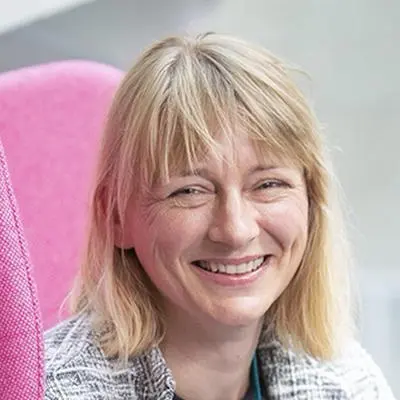
Biography
Beatrice Alex graduated in Languages, Translation and Interpreting (French and Russian) from Heriot-Watt University and received post-graduate training in computational linguistics and speech and language processing at the University of Edinburgh. She obtained her MSc in Speech and Language Processing and her Euromasters in Speech Processing in 2002 and her PhD on automatically detecting anglicisms in French and German text in 2008. After that, she held a position as a Research Fellow at the School of Informatics at the University of Edinburgh for a number of years working on text mining and natural language processing (NLP) for different applications in healthcare, biomedicine, literature and history. From 2018 until 2026, she was Chancellor's Fellow at the Edinburgh Futures Institute (EFI) and the School of Literatures, Languages and Cultures as well as Turing Fellow at The Alan Turing Institute and the School of Informatics. During this time, she was the Head of the Edinburgh Language Technology Group (LTG), a research and development group working in the area of natural language engineering at the University of Edinburgh where she also co-founded the Edinburgh Clinical NLP Group. She was promoted to Senior Lecturer in 2021.
In May 2026, she took a professorship in Artificial Intelligence at the School of Mathematical and Computer Sciences at Heriot-Watt University where her focus remains on text mining and NLP. She's currently leading NLP work in the Advanced Care Research Centre and the AIM-CISC (Artificial Intelligence and Multimorbidity: Clustering in Individuals, Space and Clinical Context) project with a focus on developing tools that can assist in predicting multimorbidity and adverse drug events to improve care in later life. Previously, she also led the NLP work as part of the Warbler and ScanDan projects with the aim to phenotype and analyse 1.7 mio Scottish brain imaging reports of the Scottish. She is also co-investigator on the DISCOVER project which used clinical NLP for identifying a cohort of potential patients to be invited for future clinical trials for stroke and dementia prevention.
On the digital humanities (DH) side, she leads NLP work as part of the Scottish Gaelic Algorithmic Research Group in the Scottish Government funded ÈIST project which has recently release a crowd-sourcing tool for Gaelic transcription called Opening the Well / Fosgladh an Tobair. She is also co-lead of the multi-site EPSR-funded project called "Unlocking AI for Languages in Britain and Ireland" which involves the creation of benchmarks for such languages to enable language "understanding" perfomrance of existing large language models (e.g. see GaelEval).
Previously, she was part of the Palimpsest project on Mining Literary Edinburgh and is one of the core developers of the Edinburgh Geoparser.