Biography
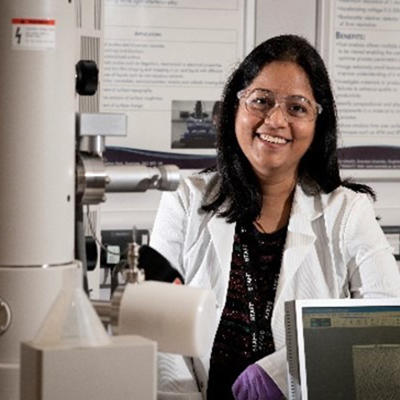
Anitha Devadoss is currently an Associate Professor at Institute of Biological Chemistry, Biophysics and Bioengineering (IB3) at Heriot-Watt University, Edinburgh, UK.
Anitha received her Ph.D. in Chemistry from School of Chemical Sciences, Biomedical Diagnostics Institute, Dublin City University, Ireland in 2011. She held several international post-doctoral research positions including a Brain-Korea-21 postdoctoral fellow at Hanyang University, Seoul, South Korea (2011-2013), a postdoctoral researcher at Tokyo University of Science, Japan (2014-2015), a Research officer at Swansea University, UK (2015-2017), Ser Cymru II MSCA COFUND Research fellow at Swansea University, which is funded by European Commission and Welsh Government under ERDF (2017-2021) and a Senior Scientist at Institute of Occupational Medicine (IOM), Edinburgh (2021-2022).
Anitha's research focuses on developing Innovative nano biosensor technologies for early point-of-care diagnostics application. Anitha's research has received funding from EPSRC, European Commission, Innovate UK, and Welsh Government.
The current projects include:
1. Developing smart nano-biosensors for monitoring food safety
This project will involve the development of highly selective and sensitive nano-biosensors for the precise detection of volatile organic compounds (VOCs) and biogenic amines (BAs) in food products via utilising 2D nanomaterials. The student will investigate the following:
- Investigate the current state-of-the-art in nanomaterials based smart food sensors.
- Develop 2D nanomaterials-based nano-biosensors for precisely detecting VOCs and BAs in food products and correlate their levels with food spoilage.
- Investigate the biosafety of the proposed 2D nanomaterials.
- Establish packaging strategies in collaboration with industry partners to incorporate the nano-biosensors for practical application.
2. Multiplex electrochemical profiling of Extracellular vesicles
Circulating biomarkers provide useful indicators of biological processes in the human body, and their concentrations in biofluids have been used for clinical risk assessment, diagnosis, prognosis, and monitoring of therapeutic outcomes. Abnormal concentrations of circulating biomarkers are associated with health conditions. This project aims to develop ultrasensitive graphene-based immunoassays for the multiplex detection of extracellular vesicles for early cancer diagnostics. Specifically, the graphene based electrochemical biosensors are promising due to its high sensitivity and selectivity, miniaturisation possibility and adaptability for large scale manufacturing. The student will investigate the following:
- Designing of multiplex graphene sensors
- Optimisation the surface chemistries for successful bio-functionalisation with the antibodies,
- Develop electrochemical sensor assays for the precise detection of tumour derived extracellular vesicle surface proteins and
- Demonstrate real-time detection of clinically validated multiple biomarkers relevant to cancer.