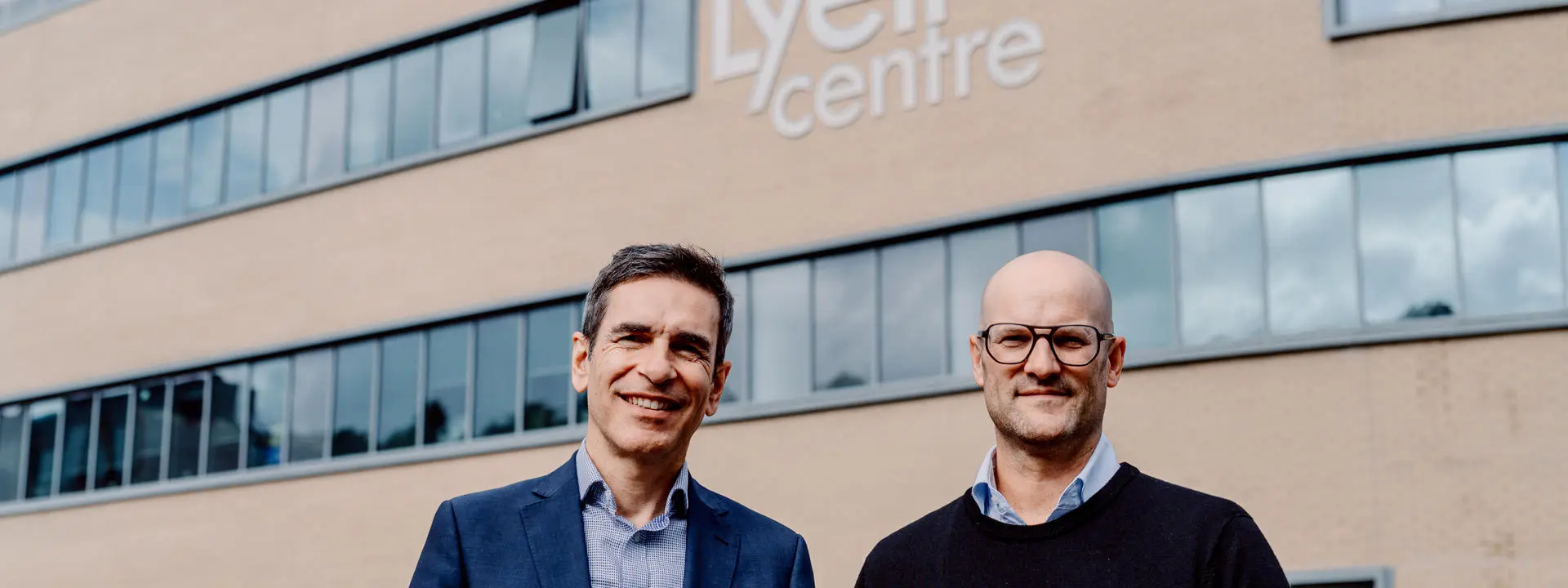
Ten years of the Lyell Centre - Q&A with Co-Directors Andreas Busch and Paul Fernandes
The last 10 years
Q. Looking back over the last decade, what achievements or milestones best capture what the Lyell Centre set out to accomplish?
Andreas: Over the past decade we created a truly interdisciplinary environment bringing Earth and marine science together, closely integrated with Heriot-Watt and connected to a wide international network of academic, industry and policy partners. Above all, we demonstrated that the global research institute concept succeeds, particularly when responsibilities are clear and a clear strategy guides the way forward.
Q. Has there been a research breakthrough, project or partnership that surprised you in terms of its direction or impact?
Paul: There are so many examples that we could share but there are two that come to mind straight away. What they have in common is that they came out of the kind of cross-disciplinary mix the Lyell Centre was designed to create.
The one that stands out most is Professor Michel Kaiser's project, 3SIP2C (Sources, Sinks, and Solutions for the Impact of Plastics on Coastal Communities in Viet Nam). What began as a marine science investigation into the sources, movement and impacts of plastic pollution evolved into a much broader programme that worked directly with the communities most affected by the problem, connecting scientific research with local knowledge, behaviour change and practical solutions.
In doing so, the project demonstrated how environmental science can deliver tangible social impact, not only improving understanding of marine pollution but also helping to inform more sustainable approaches to managing it. That ability to translate world-class research into real-world benefit was recognised in 2026, our tenth-anniversary year, when it won Research Project of the Year at the Herald Higher Education Awards.
On the pure science side, Professor Alex Poulton's ocean carbon research challenged assumptions about the strength of the ocean carbon sink. Data collected during a Heriot-Watt-led 2024 expedition to the Iceland Basin suggested that existing models may underestimate ocean CO₂ uptake by around 25 per cent, indicating that one of the world's most important natural carbon sinks could be removing significantly more carbon from the atmosphere than previously recognised.
If confirmed, the findings would have important implications for the global carbon budget, improving our understanding of where emissions end up, refining climate projections, and helping scientists produce more accurate estimates of the remaining carbon available before critical warming thresholds are exceeded.
The BGS partnership has also taken directions few would have predicted in 2016. For example, our carbon and environmental scientists, Julia de Rezende and Ryan Pereira, produced the environmental baseline for the UKGeos Glasgow observatory.
Q. The Lyell Centre was created to bring together expertise across earth and marine sciences. How has that collaborative approach evolved over the last 10 years?
Andreas: When the Centre opened in 2016, collaboration largely meant co-location: Earth and marine scientists from Heriot-Watt and BGS under one roof, with the expectation that proximity would get joint research going. Over the decade, that proximity has matured into shared activities that work best when approached bottom up rather than top down.
The clearest sign is in people. We now train students together. Joint BGS–Heriot-Watt PhD projects span geothermal energy, hydrogen storage and environmental science. BGS colleagues also teach on our MSc programmes.
The science has also moved from sitting side by side to connecting across the land–ocean interface. Work such as Ryan Pereira's ERC-funded research on land-to-ocean carbon doesn't fit neatly into either "Earth" or "marine", and that is exactly the point.
The biggest shift is in how we organise ourselves. Our Strategy 2026–2031 is structured around three challenges rather than disciplines: Climate Change, Energy Transition and Environmental Transformation. The strategy also sets missions across Science, Technology and People. Ten years ago, we asked how Earth and marine scientists could work together; today we ask which challenges we want to solve and bring together whoever is needed to solve them.
Research
Q. Can you share an example of Lyell Centre research making a difference beyond academia, whether in policy, industry, communities or the environment?
Paul: A good example on the policy side is our contribution to the UK Government's evidence review on deep-sea mining. It's a decision with long-term consequences for ocean ecosystems, and governments need independent, rigorous science to weigh the demand for critical minerals against the environmental risks. That is exactly the kind of question the Lyell Centre should try to answer.
On the industry side, our subsurface work feeds directly into the energy transition. Through SECURe, a Horizon 2020 project coordinated by BGS with Heriot-Watt as a partner, we worked on how to monitor subsurface storage sites and detect and assess leakage risk. This work is directly relevant to operators and regulators as carbon capture and storage moves from concept to deployment, including here in Scotland.
Our research on faults, seals and hydrogen storage serves the same purpose, it gives industry and regulators the confidence that what goes underground stays there.
Q. Which environmental research finding from the last decade do you think deserves more attention, and why? Andreas: Professor Alex Poulton's work on ocean carbon uptake. The Heriot-Watt-led expedition to the Iceland Basin in 2024 indicated that current models may underestimate how much CO₂ the ocean absorbs by around 25 per cent. This deserves much more attention because so much depends on those numbers including global carbon budgets and climate projections. Ultimately, the targets governments set all rest on how well we understand the natural sinks. If the ocean is doing more than we think, we need to know why, how stable that is, and whether it could change as the ocean warms.
Q. From climate change to environmental pollution, what role can research centres like the Lyell play in tackling global challenges? Paul: I see three roles, and I think centres like ours are unusually well placed to fill all of them.
The first is to provide trusted, independent evidence. The big environmental decisions of the coming decades, such as where to store CO₂, whether to mine the deep sea, how to manage our oceans sustainably, and how to adapt coastlines, will be contested. Governments, regulators and communities need science that is rigorous and that has no stake in the outcome.
The second is to connect things that are usually studied separately. Global challenges don't respect disciplinary boundaries. For example, the subsurface, the land and the ocean are one system, and so are the energy transition and its environmental consequences. That's why our Strategy 2026–2031 is organised around challenges, namely Climate Change, Energy Transition and Environmental Transformation, rather than disciplines. A centre can assemble the right mix of expertise far more quickly than a traditional department.
The third, and the most important one, is people. Our research papers are important for a specific focus, but the PhD students, postdocs and MSc graduates we train will spend the next forty years working on these problems in industry, government and academia around the world. For a centre like ours, that may be our greatest contribution to tackling global challenges.
Moving forward
Q. If you could fast-forward to the Lyell Centre's 20th anniversary, what would success look like? Andreas: Success in 2036 would be when people no longer need to ask what the Lyell Centre is. They would know it as the place to go, nationally and internationally, for integrated Earth and marine science on the questions that matter most.
Success could be shown in two ways. First, impact: our science should be visibly shaping decisions, whether that means a CO₂ storage site operating safely because of our work on faults and seals, a coastline adapted using our evidence, or ocean carbon properly accounted for in climate policy. Second, people: I'd like to see our graduates leading research groups, companies and government teams around the world, and some of them coming back to lead the Centre itself.
And personally, I would count it a success if, at the 20th anniversary, the conversation is less about what we achieved and more about what we're about to take on next.
Q. What gives you the greatest reason for optimism about the future of Earth and marine science? Paul: Clearly, the people, and particularly, the early-career researchers. Over the past few years, we have attracted researchers who could have gone anywhere based on their qualifications, but they decided to stay. That tells me we have built an environment ambitious people want to join, and they will shape the Centre's science for decades. Our PhD students give me the same confidence.
The second reason is relevance. For much of the history of our disciplines, Earth and marine science were both seen as important but somewhat removed from everyday decisions. That has changed completely. The energy transition, climate adaptation, critical minerals and ocean health are all questions where society now actively needs what we know. The demand for our science has never been greater.
Finally, working with other parts of Heriot-Watt allows us to make full use of many emerging technologies. We have strong links with our Schools of Engineering and Physical Sciences, and Mathematical and Computer Sciences, and the National Robotarium, which drives development in modern environmental sensors, platforms, and computer science. This will allow our science to be low-cost, low-carbon and low-risk, employing autonomy and machine learning to provide solutions to global problems.