Space: the emerging frontier
By Professor George Goussetis
Space services are becoming increasingly embedded in everyday life, making the resilience of these systems – against both accidental failures and deliberate disruption – critically important.
At Heriot-Watt University we are working to catalyse the creation of an ecosystem that will enhance the resilience of satellite services and applications. To maximise our impact, we are building a collaborative environment that combines world-leading research, the spin-in and spin-out of companies and collaboration in large national and international projects.
A prime example of this ecosystem is reflected in the collaboration between Heriot-Watt and Celestia UK, which established a permanent base in the university’s research park in 2021. As part of an ESA-funded project, the two organisations are working together to enhance the resilience of Position Navigation and Timing (PNT) services.
PNT services are routinely provided by satellite systems such as GPS and Galileo, which are collectively known as Global Navigation Satellite Systems (GNSS). However, these services are increasingly vulnerable to interference such as jamming and spoofing and geopolitical disruption, placing critical infrastructure at risk including mobile telephony, energy grids and financial services, as well as emergency services and defence which rely heavily on PNT services.
To address this challenge, we are working with Celestia on developing alternative solutions that deliver PNT services exploiting available satellite communication networks as signals of opportunity (SoOP). These signals are abundant, in orders of magnitude stronger than GNSS, and operating at higher frequencies – making the system more difficult to spoof or jam.
This ecosystem was further strengthened in 2025, with PNTaaS (PNT as a Service) joining the incubator in GRID (part of the university’s Global Research Innovation and Discovery ecosystem), with the aim of delivering commercial PNT services based on SoOP. Our research group is presently working with PNTaaS under a Knowledge Transfer Partnership programme to develop compact user terminal antennas for those services.
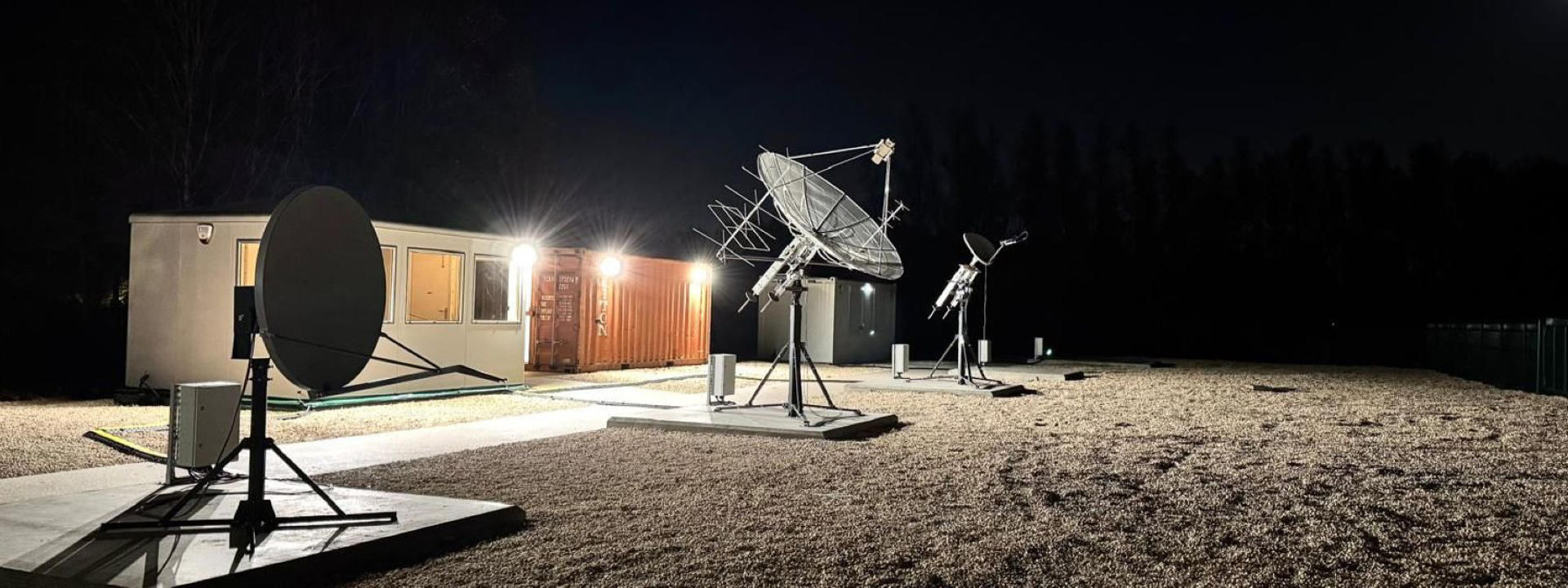
In those partnerships our team brings expertise spanning diverse engineering fields that include antenna and radio frequency electronics, digital programmable hardware, software signal processing and digital communications. Another key enabling capability underpinning these collaborations is the Satellite Ground Station (SGS) at the university’s Edinburgh campus. Funded through a UKRI EPSRC Strategic Equipment grant, SGS provides an open and flexible platform for accessing and transmitting satellite radio signals. Combined with the optical capabilities of the HOGS facility, which is also the ground segment of the SPOQC mission, this brings to the university a scarcely available ground segment capability which underpins the transition of theoretical and laboratory space technology research to a real-world environment. SGS has played a central role in our partnership with Celestia UK and PNTaaS, hosting experimentation and equipment that has accelerated PNT via signals of opportunity.
SGS also supports major national initiatives aimed at strengthening resilience in satellite connectivity. One example is the UK Space Agency funded MAMUT project. Supported by £6M, MAMUT is developing a UK sovereign highly portable user terminal that can connect with satellites across multiple networks and orbits – thereby reducing the reliance on any specific satellite operator to ensure robust connectivity. As part of this project, our team are also applying advanced AI techniques to autonomous selection among a wide range of operators across different orbits, ultimately giving delivering seamless, high-speed connectivity in even the most remote locations.
The capability we have developed in establishing SGS has also accelerated the growth of INFINECT, a Heriot-Watt spinout bringing to market electronically steerable flat panel antenna technology for multi-orbit satellite connectivity. A culmination of over 10 years of research at the university, INFINECT has already successfully demonstrated connectivity with satellites across both GEO (Geostationary) and LEO (Low Earth Orbit) and aims to support UK and European sovereign capabilities for flexible and resilient communications on the move. The distinct potential of this solution has recently been recognised by the European Space Agency, which awarded INFINECT a Business Incubation Centre grant in June 2026.
Space is inherently interdisciplinary where technologies are evolving rapidly. Heriot-Watt’s leadership in resilient space systems has been recently recognised by our role as coordinators in the €4M Horizon Europe SPARE project, which began in November 2025. Centred around Thales Alenia Space, Europe’s largest satellite integrator to whom we are now a privileged academic partner, SPARE will train 13 future space leaders across engineering, law and economics; this represents another step towards our vision for a sustainable, resilient and competitive future for a UK and European sovereign space sector, which we strive to support in partnership with our academic, industrial and governmental partners.
More about this author
See moreGeorge Goussetis is professor of satellite communications and antenna engineering and Associate Executive Dean for Enterprise and Entrepreneurship at Heriot-Watt University.