Final year student poster designs shine a light on Centre for Sustainable Brewing and Distilling
Heriot-Watt University is no stranger to a challenge, with our global community seeking solutions to the world’s most pressing issues. When it comes to climate change, we aim to reach net-zero operational emissions by 2035.
Heriot-Watt has long championed innovation with purpose. Across our campuses, researchers, students and industry partners are developing practical solutions that accelerate progress towards net zero. Our commitment to the UN-backed Race to Zero campaign reflects more than ambition; it’s a call to action to use our expertise in science, engineering and enterprise to create real-world impact.
An example of this is the development of the new Centre for Sustainable Brewing and Distilling (CSBD), designed to help the brewing and distilling sectors tackle the environmental challenges of the 21st century.
But what will the building look like? How can it lead the way in terms of its own sustainability, design and net-zero ambitions?
To that end, two different parts of the university – the International Centre for Brewing and Distilling, and the School of Energy, Geoscience, Infrastructure and Society (EGIS) – came together to set a unique competition at the beginning of the new academic year.
The students were placed into multidisciplinary teams and given five days to design a poster and produce a video pitch, on what a net-zero CSBD should look like.
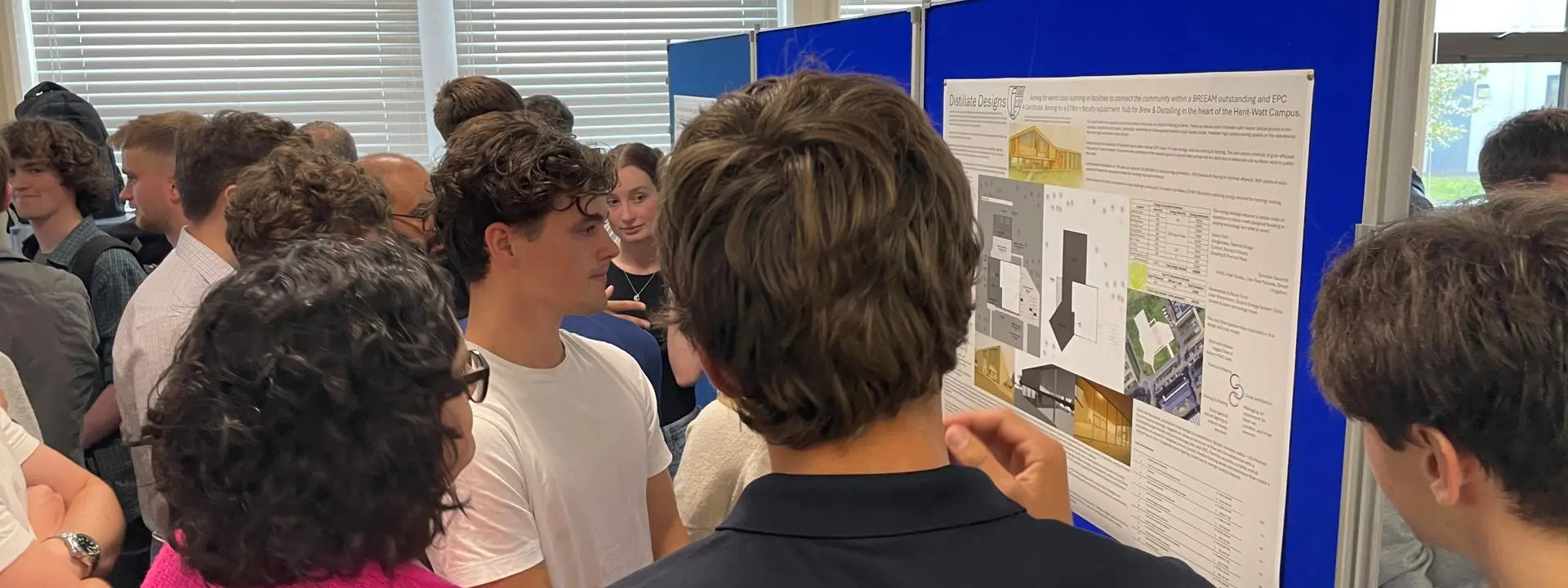
By the end of the week, the William Arrol Building was packed with over 100 students, showcasing their final in-depth designs and videos. They were ready to be analysed by Professor Dawn Maskell, of the International Centre for Brewing and Distilling, Associate Professor Alex MacLaren, from the Institute for Sustainable Building Design, and colleagues from across disciplines.
The competition had an incentive – prize-winners were named for both ‘Best Teamwork’ and Best Design Solution’.
Each design brought a refreshing look at ‘best practice’ – not only in terms of sustainability, materials used and accessibility but also how it could interact with the campus community and get people coming through its doors.
One group, called the Joint Beer Design Team, produced a three-storey design including advanced teaching spaces and ‘biophilic’ design green walls on the exterior to reduce heat loss by 30%. But it also included a smart greenhouse where excess rain could be filtered and reused, a rooftop beer garden for social events.
Joint Beer team member Daniel Cockerill, studying Geography, said: “We focused on three main pillars – education, sustainability and innovation. For instance, in terms of innovation, every room would have a suspended ceiling to absorb sound and reduce echo. We believe acoustic comfort for those using the CSBD is extremely important in a building like this.”
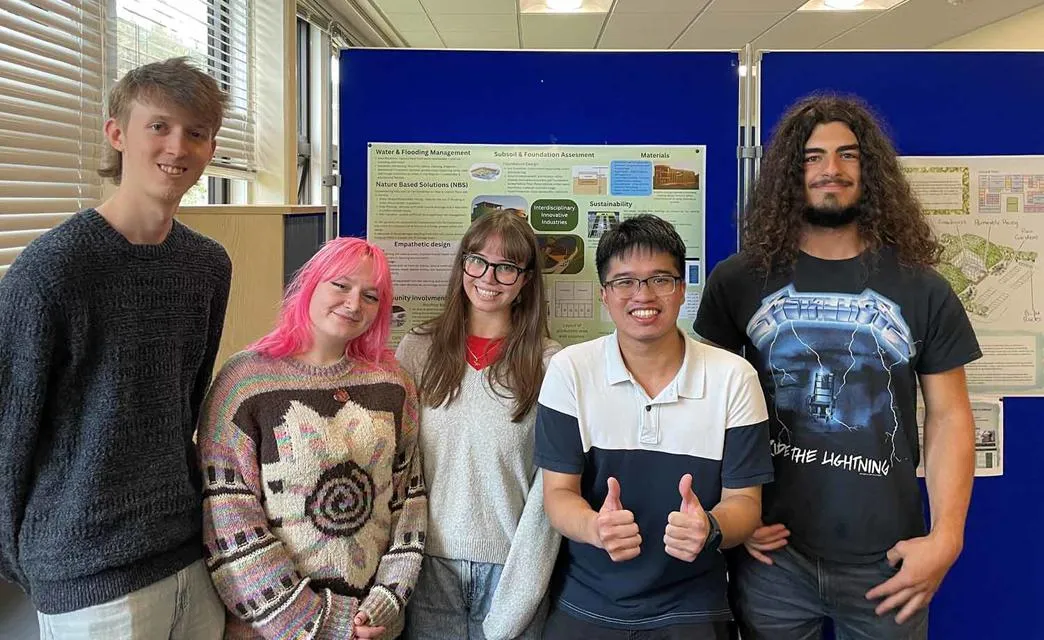
Another team, Interdisciplinary Innovative Industries, focused on creating a self-sustaining vehicle with net-zero at its heart.
Jet Pang, who is studying Quantity Surveying, said: “Net-zero is a priority and involved every aspect of our design, from the foundations up. We focused on nature-based solutions such as grass verges, sustainable paving, tree planting and rain gardens to provide natural drainage and reduce carbon dioxide levels. Heat was also a key feature, with heat recovery from wastewater, rainwater harvesting to reuse in the building, for instance for toilets, and wastewater treatment.
“We also factored in sourcing materials from local suppliers, and followed Scottish Government policies around the circular economy.”
Fellow team member Amy Renny, who is studying Architectural Engineering, added: “The main point of our design was the building must be self-sustaining. We incorporated as much sustainability as possible, including a microalgae façade, similar to the BIQ House in Germany’s Hamburg. Their wall contains microalgae that generates heat and biomass from sunlight, used to supply the building with energy. Such as wall was a key part of our design for the CSBD.”
Meanwhile, a team called Malt Masters believed three key main points were a vertical structure, a nature-based solution, and ways to boost community engagement.
Sorley Todd, studying Quantity Surveying, said: “One of our USP ideas is for a drying floor. It’s stemmed from seeing how biomass plants on farms use the excess heat to allow for woodchip to be dried out. We believe this can be used for grain, which brings in a commercial aspect for the university, if they choose to adopt this.”
Reinventing Brewing’s Dima Mohamed, studying Architectural Engineering, focused on a building that split the working section from the community section – with a courtyard in the middle.
He said: “We looked at the foundations of the building in terms of using low-carbon concrete, to reduce carbon emissions by up to 70%. Also we designed the car park and courtyard with a sloped design so rain water could run off into swales. Plants that absorb water would absorb the water, and also provide a habitat for wildlife.
“But in the building itself, we wanted a shape that includes the brewing and university aspect with a community benefit aspect – including a brew and beer café. The CSBD would be in an area of the university that is a distance from the main campus. It is vital to include things that will bring people into the building naturally.
“As part of the design, we included a heat recovery system that would take the heat from the brewing and distilling process and redistribute it to other parts of the building, including the café.”
Future Proof Fermenters also focused on community engagement. Jay Dickson, studying Civil Engineering, said: “Our overall design has split the layout into malting, brewing and distilling with their lecture theatres, while a café, terrace and rooftop bar can provide the opportunity to bring community events into the building – boosting engagement.
“Making sure the building is busy is a hugely important part of sustainability. So, we have provided the space to open it up so communities outside of just brewing and distilling can access it.”
These are just a few of the teams who presented posters on the day. But a recurring theme of all was the focus on sustainable materials – from the foundations up – as well as showcasing ways to open up the building to students from other departments, and the community at large.
Professor Maskell said: “It was a fascinating day, and I want to thank the students for their critical thinking and detailed posters. The work completed by each team was of a very high-quality, and was achieved in a very short space of time.
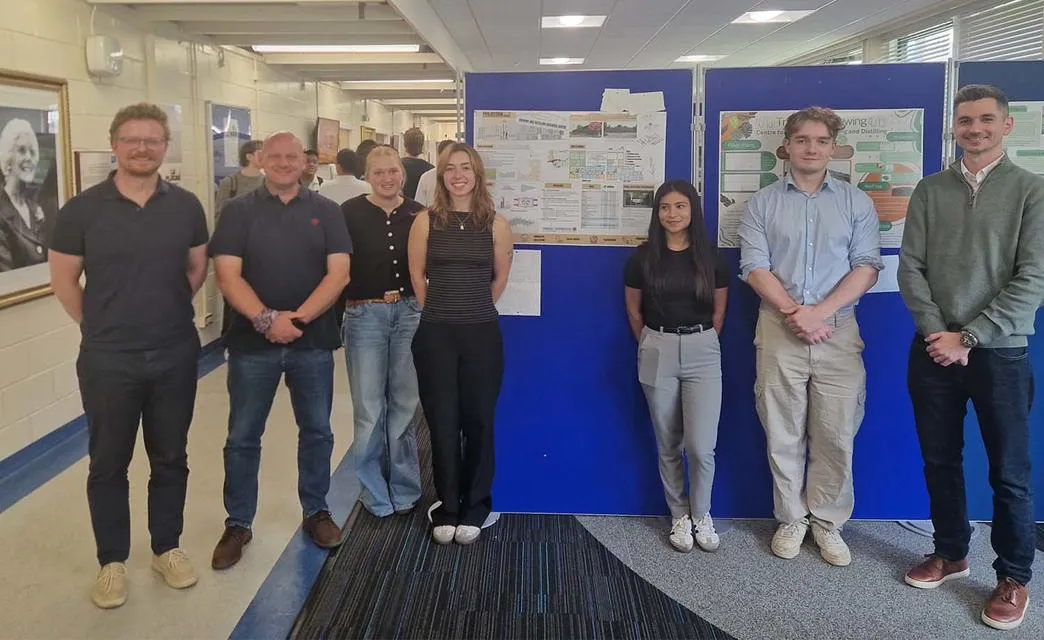
It proved very hard to pick winners, but for ‘Teamwork’, the Interdisciplinary Innovative Industries team won the votes.
“It was a challenge for sure, we all had different roles. It was a challenge, not as instance before. Very interesting before.
Overall, ‘Best Design Solution’ was awarded to Projection Studios, whose designs shone through.
Professor Maskell added: “However, all the students have given the university and its CSBD design team food for thought in terms of how the final Centre for Sustainable Brewing and Distilling will look.”
Associate Professor MacLaren said: “I am extremely impressed with all of the posters, and the hard work and dedication of all the students. Coming back to university, we did throw them in at the deep end – and they all responded magnificently.
“I hope that the ICBD now has plenty of opportunity to study the designs in greater depth, so that they can take on board all the innovative ideas that were created and shape a CSBD that is truly sustainable, inclusive and delivers a bright new future not only for brewing and distilling but the university and its communities.”