Towards a sustainable urban future: learning from communities in the Global South

Prof. Harry Smith is a Professor in Global Urbanism at Heriot-Watt University and Deputy Director of The Urban Institute , which brings together a group of economists, sociologists, geographers, planners and urban designers with the aim to contribute to creating sustainable, resilient and just cities.
In a world facing increasing and multiple crises – from climate change-related weather events to rising poverty – many voices call for greater recognition and enablement of the power communities have to respond at the local level. In many ways, communities have become disempowered over time in the Global North, with the rise of strong government structures during the twentieth century and more recently, growing reliance on the private sector for provision of goods and services including in our urban environments.
Communities in the Global North could learn from community organisations in the Global South. There, the challenges posed by rapid urbanisation, government structures which may be insufficient or ineffective and weak development of the private sector provide a context where community ingenuity, resourcefulness and solidarity are essential.
In our action-research with community organisations in low-income neighbourhoods in Brazil, Colombia and Mexico, we have worked together to map flooding and landslide hazards and resources to tackle these. We have set up hazard monitoring systems where local residents collected and analysed data together with scientists. We have supported direct community action in building low-cost mitigation works to protect their homes. And we have facilitated and supported negotiations between community organisations and local government agencies in their search for wider and longer-term disaster risk management strategies for their neighbourhoods and cities.
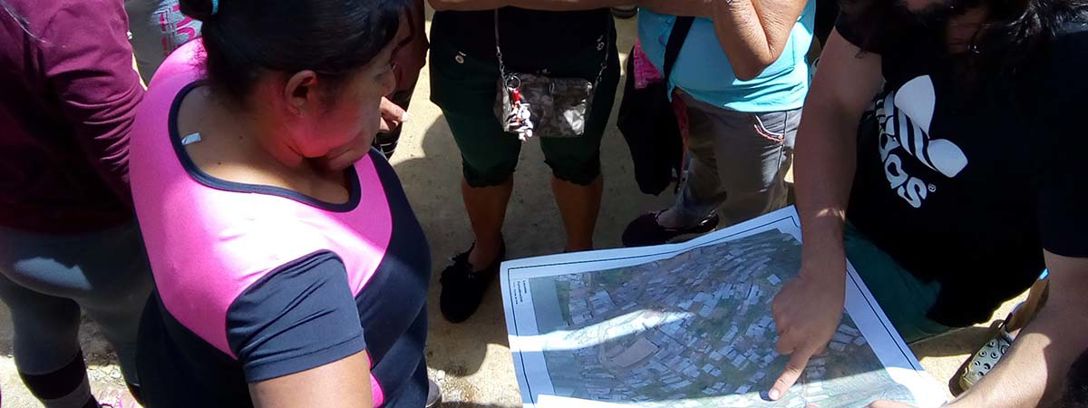
These communities have learnt about geological and weather events, and scientific data collection and analysis, and we have learnt from them how these impact their daily lives and how they mobilise knowledge to fight for better and safer homes. With the livelihoods of their members at stake, some of their community organisations are innovators in pressing their local governments for more highly integrated approaches that bring together neighbourhood improvement, disaster risk management and climate change action. In this process, they also inspire us, in academia, to think in more integrated ways in order to continue to support them.
But acknowledging the capacity of communities doesn't mean expecting them to solve all their problems on their own. As campaigner Tracy Washington in Louisiana famously put it: 'Stop calling me resilient' – asking instead for the issues that create the need for communities to be resilient, to be fixed in the first place.
The idea of helping communities increase their resilience does risk putting all the onus on them, while ignoring wider inequalities that require government intervention at both local and national levels. But 'resilient' communities can be very good at identifying and calling out such inequalities. For example, the community organisations we're working with on landslide mitigation in Medellín, Colombia, query and challenge the differences in local government infrastructure investment in high- and low-income areas.
Indeed, the aim of much of the work we have done, in collaboration with community organisations in Latin America, has been to bring about local government action that addresses the issues being faced by vulnerable communities, but on their terms. And the process to achieve this is a 'dialogue of knowledges' – as it is known in parts of Latin America – which equally values and mobilises the types of knowledge held by communities, government agencies and academia.
This dialogue can be extended to international learning to help us all address the compounding challenges we face to reach a sustainable urban future, but this needs to be based on a full understanding of both the challenges and the feasible and equitable responses, in each context. And this is where we, as researchers, working in collaboration with local communities and local governments, can help.
Find out more about the The Urban Institute.