World’s top Human Robot Interaction experts unite in Edinburgh
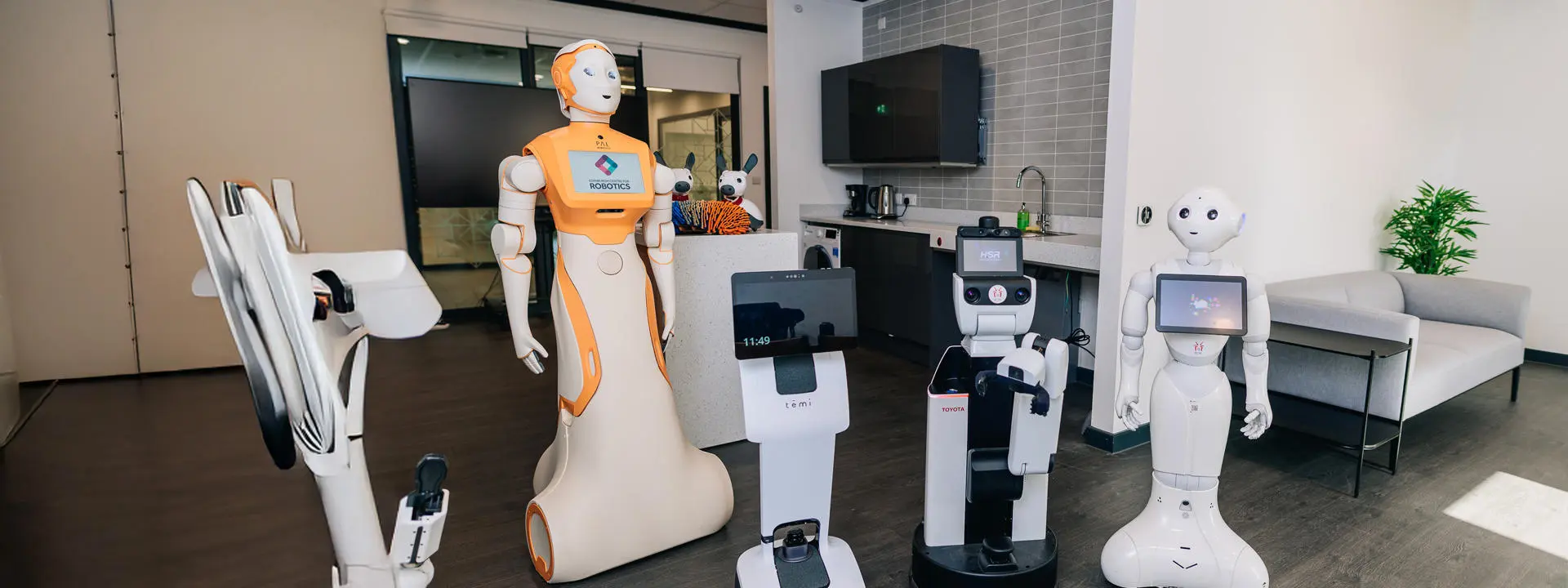
Experts using robots to help autistic children, support independent living, transform healthcare and improve people’s everyday lives will attend a major international conference with free public event.
Robots that help autistic children to develop communication skills and tech to support people to live independently are just two of the 850 robotic technologies featuring at this year’s Human Robot Interaction Conference.
Human-robot interaction focuses on how we design technologies that work for people in real situations.
Lynne Baillie
General Chair of HRI 2026 and a scientist at Heriot-Watt University
The conference centres on two defining questions for the field, including how robots can be woven into everyday life like workplaces, hospitals and homes without creating inequality or displacing the people they are meant to serve.
It will also explore how the technology itself can be made genuinely accessible, from intuitive design and affordability to interfaces that do not require an engineering degree to navigate.
The goal, researchers argue, is not simply smarter machines but machines that people genuinely want to use.
The world’s leading human-robot interaction researchers are gathering in Scotland for the first time, bringing some of the biggest names in robotics and technology to the capital including Amazon, Google, Honda and Meta. Edinburgh now joins a distinguished list of previous host cities spanning the US, Europe, Asia and Australia.
Scotland is already playing an important role in shaping the future of robotics. With the right investment and collaboration between government, universities and industry, we can remain at the forefront of developing technologies that transform society.
Lynne Baillie
General Chair of HRI 2026 and a scientist at Heriot-Watt University
The conference comes as the Scottish Government increases investment in robotics and autonomous systems, with recent initiatives including the Robotics Adoption Fund and the Scottish RAS Cluster Pilot, both being delivered by The National Robotarium at Heriot-Watt University. Ministers have identified the sector as having transformational potential across healthcare, education, manufacturing and public services.
Among the technologies on show is QTrobot, an expressive social robot designed to help autistic children develop communication and social skills. Developed by LuxAI, a spinout from the University of Luxembourg, it uses interactive games, visual prompts and movement to create a structured, engaging learning environment.
Also being showcased is Reachy Mini, an open-source humanoid robot developed by French company Pollen Robotics. As part of their work, researchers are using robotics to explore how technology can handle everyday objects, navigate real environments and collaborate with people in homes, hospitals and workplaces.
From the USA, Semio is a software startup defining the way people will live, work and play with robots in their everyday lives. Semio is showcasing its latest software that allows robot developers to rapidly create and deploy robot apps and allows robot end-users to easily access and use robot apps via natural communication, including both speech and body language.
Researchers and organisations working on socially assistive robotics will present insights into how robots are being deployed in therapy and special educational needs settings, exploring how technology can support teachers and therapists while reducing barriers to access.
A special session, supported by Meta, will look at how humanoid robots move from lab prototypes to living rooms and ask what people actually need and question how we build machines worthy of a place in our homes.
And as researchers pull back the curtain on methods like Wizard of Oz – an experiment in which people believe the robot is acting autonomously while being operated or partially operated by an unseen human – the session will explore the ethical and human costs of the wizards behind the machine.
Lynne Baillie, General Chair of HRI 2026 and a scientist at Heriot-Watt University, said: “Human-robot interaction focuses on how we design technologies that work for people in real situations.
"We are already seeing robots used to support learning, healthcare and independent living.
“Hosting HRI 2026 in Edinburgh is a significant moment for Scotland. It highlights the strength of robotics research taking place here and brings international expertise to share ideas, technologies and experiences.
"Scotland is already playing an important role in shaping the future of robotics. With the right investment and collaboration between government, universities and industry, we can remain at the forefront of developing technologies that transform society.”
Members of the public are invited to meet the robots and the researchers building them at a free event on Tuesday 17 March (16:30–18:00) at the EICC. Visitors can explore live demonstrations, take part in hands-on activities and speak directly with scientists and engineers. The event is open to all. To reserve a place, and for more information, follow this link. Please note, registration closes at 3pm on Tuesday 17th March.
The International Conference on Human-Robot Interaction (HRI 2026) takes place at the Edinburgh International Conference Centre (EICC) from 16 to 19 March and is sponsored by the Association of Computer Machinery (ACM) and Institute of Electrical and Electronics Engineers (IEEE).