Study sheds new light on why 55 pilot whales stranded on Lewis
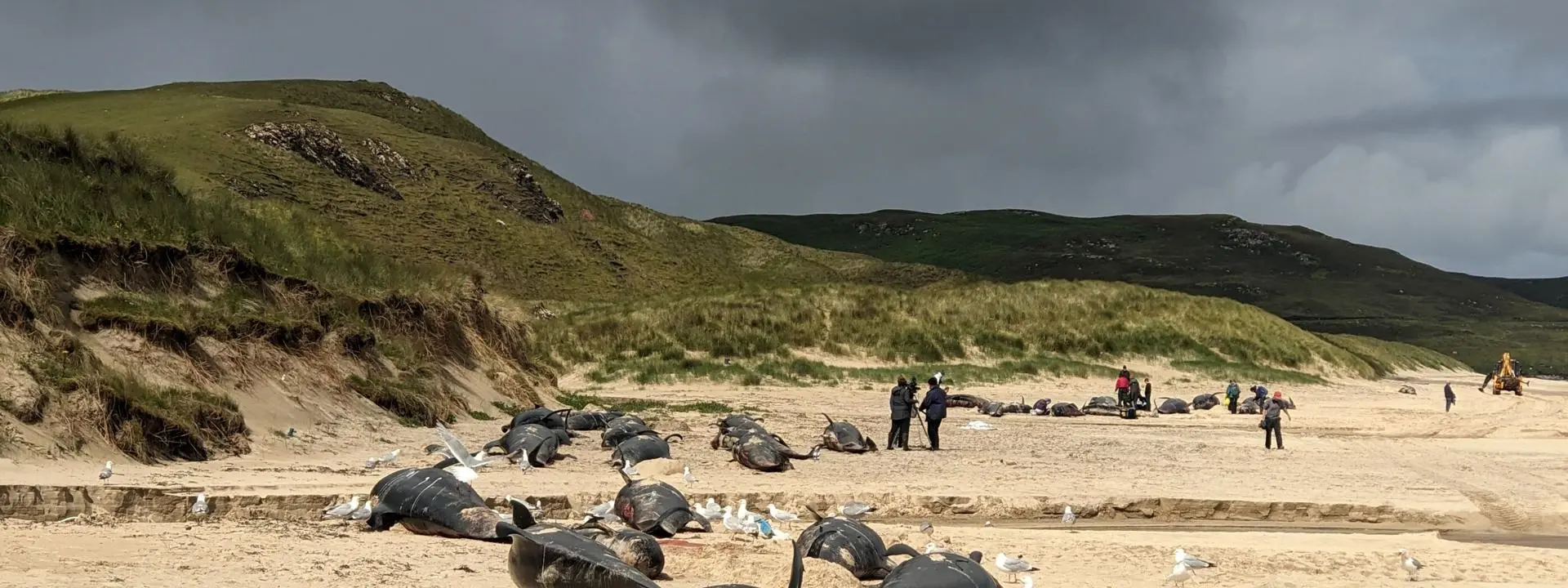
A new study investigating one of Scotland's largest-ever mass strandings of long-finned pilot whales has helped scientists narrow the possible causes of the event, which saw 55 whales come ashore on the Isle of Lewis in July 2023.
The research, led by Anna Kebke of the University of Glasgow and the Scottish Marine Animal Stranding Scheme (SMASS), used stable isotope analysis to reconstruct the recent feeding history of long-finned pilot whales involved in the Tolsta mass stranding.
Working at the Lyell Centre for Earth and Marine Sciences, Heriot-Watt University, the team analysed carbon and nitrogen isotopes in muscle, skin and liver samples collected during post-mortem examinations, enabling them to examine feeding patterns over different periods of the animals' lives, from months before the stranding through to the final weeks.
The study found no evidence of a shared, large-scale shift in diet or feeding grounds across the stranded animals before they came ashore.
The result builds on earlier investigations which showed the whales were generally healthy and in good nutritional condition prior to death. Taken together, the evidence suggests that a sudden change in prey availability or feeding habitat is unlikely to explain why a large group of offshore-dwelling whales entered shallow coastal waters where they ultimately became stranded.
Lead researcher Anna Kebke said: "Stable isotopes provide a unique window into an animal's recent life. By analysing muscle, skin and liver samples, we were able to trace aspects of these whales' feeding history from months before the stranding through to the final weeks.
"Although we found no evidence of a major shared change in diet or feeding grounds, that result is important. It helps narrow the possible causes of the stranding and builds a clearer picture of the factors that may have contributed to this unusual event."
Researchers suggest that the results help narrow the possible causes of the stranding and add weight to evidence suggesting that social factors may have played an important role.
Genetic analyses from the wider investigation found that the stranded whales belonged to several different family groups rather than a single closely related pod, raising the possibility that a large social aggregation had come together in Scottish waters before the event.
The study also highlights the value of stable isotope analysis as a tool for future stranding investigations. By providing a chemical record of an animal's feeding history, the technique can help scientists understand what happened in the weeks and months before a whale strands, alongside evidence from pathology, genetics and acoustics.