Study finds choice of team car could decide the Tour de France
Elite athletes competing in the Tour de France could gain more than eight seconds in the individual time trial depending solely on the type of team car following them, a new study has revealed.
The research, the third in a pioneering series by the world's leading experts on cycling aerodynamics, shows that a car driving behind a cyclist gives the rider a measurable aerodynamic push, and that the size and shape of that car could be the difference between winning and losing.
Led by Heriot-Watt University in Scotland, in partnership with Ansys, part of Synopsys, the study comes ahead of the Tour de France individual time trial on Tuesday 21 July, a 26.1km stage from Évian-les-Bains to Thonon-les-Bains.
You might say these are small numbers, but elite time trials are sometimes decided by a tenth of a second, or even a hundredth. In that context, these gains are enormous. They could determine who wins the Tour de France time trial.
Bert Blocken
Head of the Aerospace Engineering Cluster in the School of Engineering and Physical Sciences at Heriot-Watt University
Professor Bert Blocken, Head of the Aerospace Engineering Cluster in the School of Engineering and Physical Sciences at Heriot-Watt University, said: "When a cyclist rides, they create an area of overpressure in front of them that holds them back, and an area of suction behind them that pulls them back, causing resistance.
"But a car creates the same effect on a much larger scale. It pushes a big bubble of overpressure ahead of it, and when the car drives close behind a cyclist, that bubble partly cancels out the suction behind the rider, providing the cyclist with a meaningful boost.
"At a distance of just one metre, a rider's aerodynamic resistance drops by almost 14 per cent, which is massive.
“The benefit falls away quickly as the distance grows, but it never reaches zero, not at 10 metres, not even at 30.
"You might say these are small numbers, but elite time trials are sometimes decided by a tenth of a second, or even a hundredth. In that context, these gains are enormous. They could determine who wins the Tour de France time trial."
Professor Blocken and his team’s work directly changed the sport. In 2023, the Union Cycliste Internationale (UCI), cycling's world governing body, extended the minimum distance between rider and following car in individual time trials from 10 to 25 metres.
A second study by the team, in 2024, showed that stacking multiple bicycles on a team car's roof increases the push effect further, prompting the UCI to urge teams not to exaggerate the practice.
This new study, titled “Cyclist aerodynamic resistance is influenced by the type of the following team car” asks a question the sport has never scientifically answered, does it matter which car follows the rider?
The researchers found the benefit a rider receives depends on only two factors, the distance between the rider and the car, and a single number describing the car's aerodynamics, its drag area, known as CdA.
The CdA is a measure of the size and streamlining of the car: the bigger and more blunt the vehicle, the higher its CdA, and the bigger the push it gives the rider ahead.
Professor Blocken said: "There is a very simple way for the UCI to avoid too large unwanted benefits. First, impose a maximum CdA value for team cars, so no team can gain an excessive advantage simply by choosing a bulkier, less aerodynamic vehicle.
“And second, enforce the following distance, ideally the cars would be 40 or 50 metres back, but at the very least the existing 25-metre rule should be enforced by visual inspection until measurement technology is in place. The rules should simply be changed, and then we are done with it."
UCI rules currently allow teams to freely choose their team car for individual time trials, and in practice, a range of estate back cars but also the Jaguar F-Type, famously used by Team Sky, has appeared in time trials.
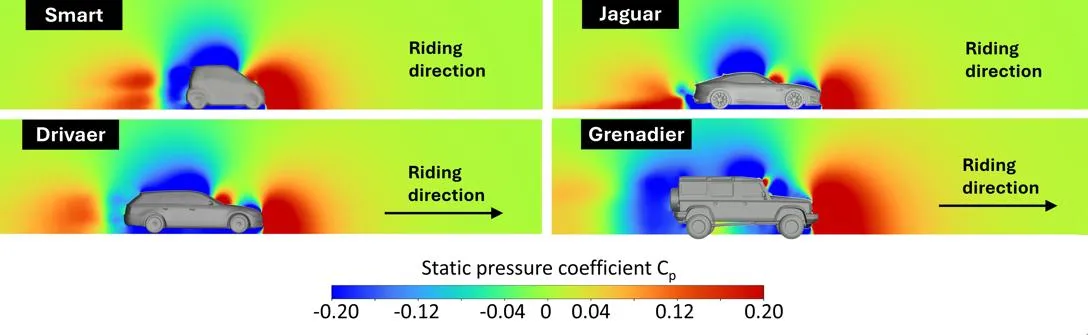
Using advanced computational fluid dynamics (CFD) simulations validated by wind tunnel measurements, the researchers tested eight vehicles: a Mercedes Smart Fortwo, a Jaguar F-Type, a typical estate car, a typical SUV, the Ineos Grenadier Station Wagon and three vans.
The results show a clear pattern, the bigger and less aerodynamic the following vehicle, the bigger the push it gives the rider in front.
The small, streamlined Smart Fortwo gives the rider the least assistance. The boxy Grenadier Station Wagon gives the most of any car tested, and the vans exceed even that.
At a following distance of 10 metres, a rider followed by a typical estate car would gain 2.3 seconds over the Tour de France time trial course, but a rider followed by a Grenadier Station Wagon would gain 5.5 seconds.
Thierry Marchal, Program Director for Healthcare and Sport Solution, Ansys, Part of Synopsys, said: "In professional cycling races, every detail matters, but some might be more important than others. Numerical simulations let cycling teams see what’s invisible, like airflow, and quantify how different factors affect performance.”
“This research by Prof. Bert Blocken and his team shows that the shape of the car following a cyclist can have a big impact, even for cars 25 meters behind. This surprising finding could push international cycling authorities to set new rules or, in the meantime, encourage teams to take advantage of it. Using numerical simulations gives teams a clear edge to innovate faster and potentially win more races."
Dr Frédéric Grappe, Head of Performance of the French cycling team Groupama-FDJ United, stated: “A car indeed has the capacity to push a certain volume of air forwards in the direction of the cyclist during the time trial, so it gives him an aero advantage. As Prof. Bert Blocken’s new study shows, taking the shape of the car into account is of paramount importance to provide unfair aerodynamic benefits.”
The team has communicated its findings and recommendations to the UCI.