Scott Arthur MP visits Heriot-Watt University to discuss a sustainable future for UK electronics
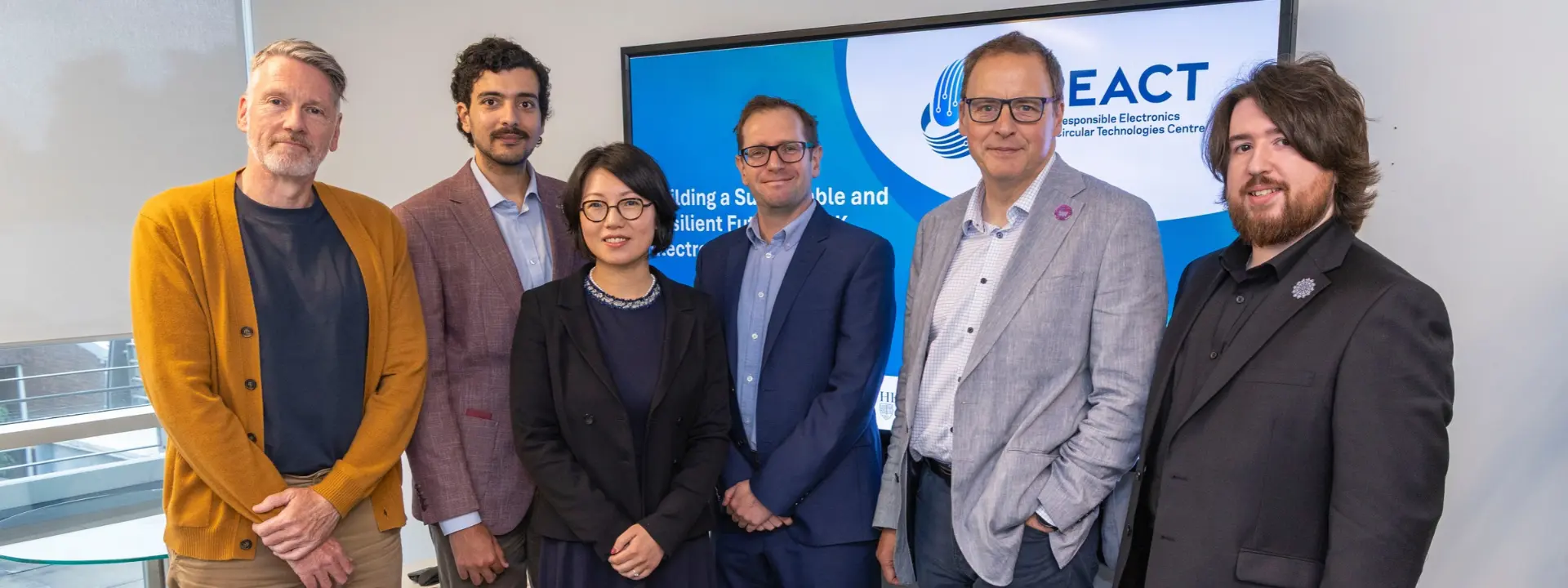
On Monday 17 August 2026, Dr Scott Arthur MP visited Heriot-Watt University's Edinburgh Business School to meet researchers from the Responsible Electronics and Circular Technologies (REACT) Centre and discuss how research, innovation and policy can support a more sustainable, circular and resilient UK electronics sector.
The visit brought together REACT research Pillar Leads from Heriot-Watt University, the University of Glasgow and the University of Edinburgh, showcasing the complementary expertise across the Centre, from sustainable finance and engineering to chemistry.
Visit highlights
- Researchers showcased REACT’s work spanning sustainable materials and manufacturing, digital technologies, circular economy and supply-chain resilience, and the sustainable recovery and recycling of critical metals.
- Discussions explored some of the major sustainability and resilience challenges facing the UK electronics sector, including electronic waste, dependence on critical raw materials and global supply-chain risks.
- The visit concluded with a roundtable discussion on how research, industry and policymakers can work together to accelerate the transition towards a more sustainable, circular and resilient electronics sector.
REACT is the UK’s first cross-institute sustainable electronics centre, bringing together the Universities of Glasgow, Edinburgh and Heriot-Watt, the Compound Semiconductor Applications Catapult, and a growing network of industry and public-sector partners.
The Centre is supported by more than £6 million of investment from UK Research and Innovation (UKRI) and industry and takes a whole-system approach to addressing the sustainability and resilience challenges facing the electronics sector.
Electronics underpin almost every part of the modern economy, but the sector faces significant challenges from carbon emissions and growing volumes of electronic waste to dependence on critical raw materials and increasingly complex global supply chains.
REACT brings together expertise across low-impact materials and sustainable manufacturing, semiconductors and digital technologies, critical raw material recovery and recycling, circular economy, supply chains, finance, policy and responsible innovation. Its aim is not only to develop more sustainable technologies, but also to address the wider financial, business, policy and societal barriers that determine whether innovations can be successfully adopted and scaled.
Bringing together expertise across three universities
During the visit, REACT researchers from the three universities presented complementary areas of the Centre’s work.
Researchers from the University of Glasgow discussed sustainable electronics, including developments in materials, manufacturing and digital technologies.
Professor Bing Xu from Heriot-Watt University's Edinburgh Business School discussed supply-chain risks and the role of circularity in strengthening the resilience and competitiveness of the UK electronics sector, including how finance, business models and policy can support the transition towards a more circular electronics economy.
Researchers from the University of Edinburgh presented their work on the sustainable recovery and recycling of critical metals, highlighting the importance of retaining valuable materials within the economy and reducing dependence on primary resources.
The presentations were followed by a roundtable discussion with Scott Arthur MP on the opportunities and challenges facing the UK electronics sector, and how research, innovation and policy can work together to support the sector’s transition.
Professor Xu, who leads REACT’s work on finance and is the Director of the Centre for Financing a Sustainable Future, society and policy, said:
“Building a more sustainable and resilient electronics sector requires more than technological innovation alone. We need to consider the whole system — from how products are designed and manufactured to how materials are recovered and reused, and how finance, business models and policy can support the adoption of these innovations at scale.
“Scott’s visit provided an important opportunity to discuss how research, industry and policymakers can work together to accelerate the transition towards a more circular electronics economy, while strengthening the resilience and competitiveness of the UK electronics sector.”
Scott Arthur MP said:
“It was great to be back at Heriot Watt University to visit the REACT team and hear more about the vital work being done in our electronics industry. The team demonstrated how a whole system approach will be critical in ensuring a more sustainable future through every stage of electronics production, use, and reuse. I am proud to have such an innovative project and team working in Edinburgh South West.”