Scotland’s stark mortality inequalities mapped by neighbourhood in unprecedented detail
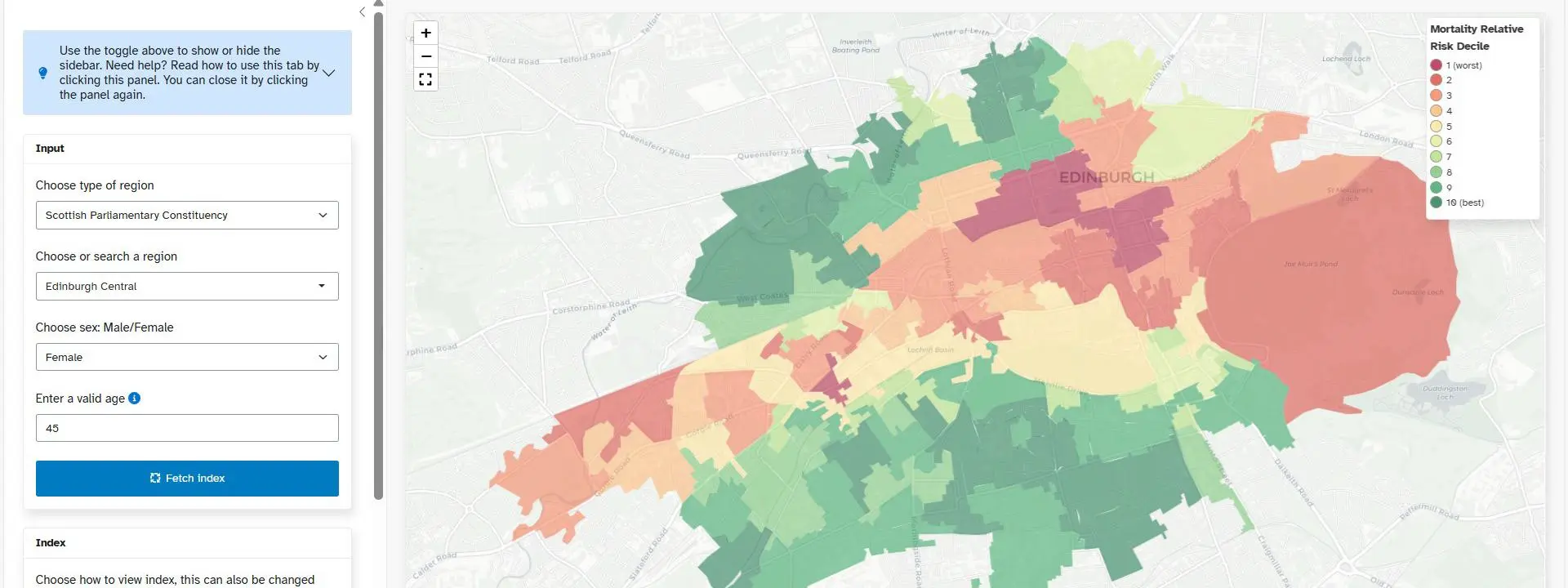
A new digital tool launched today by Heriot-Watt University has revealed differences in life expectancy between neighbourhoods in Scotland of up to 20 years. The Index of Scottish Life Expectancy (THISLE) maps in unprecedented detail for the first time reliable and highly localised estimates of mortality rates and life expectancy across the country, showing stark inequalities.
The App has been developed by researchers in the School of Mathematical and Computer Sciences at Heriot-Watt and the Research Centre for Longevity Risk at the University of Amsterdam (RCLR). Heriot-Watt’s Mathematical-Driven Innovation Centre (M-DICE) provided technical support.
THISLE is a powerful example of how advanced statistical science can illuminate the realities of people’s lives in ways that were previously impossible.
Professor Sara Lombardo
Executive Dean of the School of Mathematical and Computer Sciences, Heriot-Watt University
Professor Andrew Cairns is the lead researcher from Heriot-Watt University. He said: “This app is important because it finally gives Scotland the ability to understand mortality inequalities at the level where people actually live—the neighbourhood.
“Until now, we’ve only had broad, area‑wide measures that can mask the true scale of local variation.”
The THISLE index is based on the latest 2024 mortality data from the National Records of Scotland. It covers all 6,976 Scottish Data Zones, each representing around 800 residents.
Using advanced statistical modelling, the App offers two key measures. Mortality Relative Risk compares neighbourhood mortality rates to the national average by sex, age, and year. Life Expectancy estimates average life expectancy from different starting ages for men and women in each area.
THISLE shows that life expectancy from birth varies by almost 20 years between the highest‑ and lowest‑performing neighbourhoods. 18% of neighbourhoods have mortality rates less than half the national average. 8% of neighbourhoods have mortality rates more than double the national average. Amongst men, the highest‑risk 1% of areas have mortality rates 12 times higher than the lowest‑risk 1% in the 40-59 age group.
Our hope is that this tool empowers policymakers, health services and local organisations to target interventions where they are needed most.
Professors Andrew Cairns and Torsten Kleinow
THISLE lead researcher at Heriot-Watt University; Director of RCLR, University of Amsterdam
While some predictors of mortality align with long‑established evidence, such as unemployment and educational attainment, others are unexpected, especially in terms of their magnitude. Higher marriage rates and net in‑migration around retirement age are both linked to significantly lower mortality — for men in particular. Inequalities peak around age 40 and are consistently wider for men than women.
Professor Sara Lombardo, Executive Dean of the School of Mathematical and Computer Sciences, underlined the significance of the research: “At Heriot‑Watt, we are committed to research that delivers societal impact.
“THISLE is a powerful example of how advanced statistical science can illuminate the realities of people’s lives in ways that were previously impossible.
By bringing together cutting‑edge modelling with highly localised data, our researchers have created a tool that exposes the true scale of health inequalities across Scotland.”
THISLE provides more precise and localised estimates than the Scottish Index of Multiple Deprivation, giving sex‑ and age‑specific data at true neighbourhood scale.
Professor Cairns and Professor Kleinow, Director of RCLR, said: “Our hope is that this tool empowers policymakers, health services and local organisations to target interventions where they are needed most, and to understand the social factors that shape these stark differences in health outcomes.”
The mapping tool can be accessed at: https://m-dice.shinyapps.io/thisle/