Robot helps transform cardiovascular health checks in Scottish NHS GP surgery
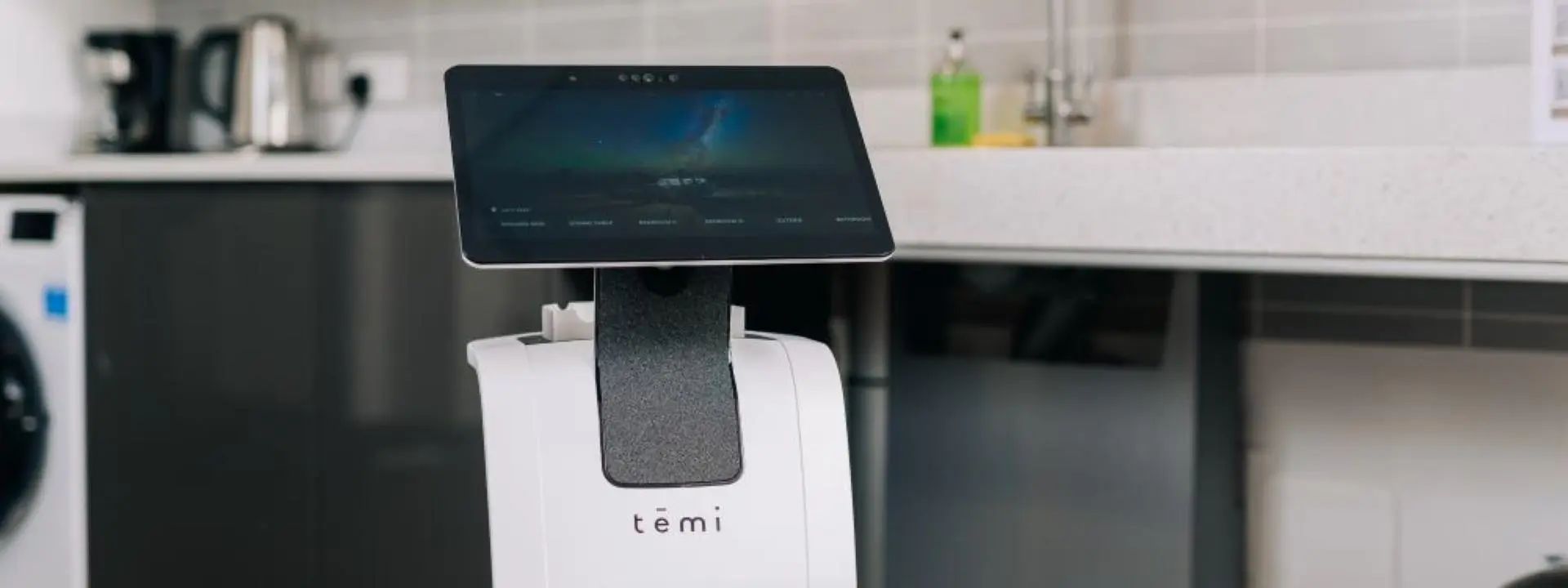
A robot capable of conducting annual cardiovascular health checks has been trialled at a Dundee GP surgery, in what researchers believe could point to a practical, scalable model for reducing pressure on NHS primary care.
The HEART-POD project is a collaboration between The National Robotarium and Edinburgh Business School, both Heriot-Watt University, Erskine Medical Practice (NHS Tayside), supported by Tay Health Tech and the Engineering and Physical Sciences Research Council (EPSRC). It saw a commercial robot, known as a ‘Temi’, adapted and customised by the National Robotarium engineering team and deployed at Erskine Practice, Arthurstone Medical Centre where it guided patients through routine biometric measurements and health questionnaires as part of their annual cardiovascular disease review process.
The robot, which moves on wheels and has a touchscreen interface, is able to greet patients on arrival, direct them to the health assessment area, and autonomously guide them through a series of measurements - including height, weight, blood pressure, and oxygen saturation - using video demonstrations and verbal feedback. Patients can interact with the system using either its touchscreen or voice commands, with spoken responses processed through a Large Language Model and coded automatically into their corresponding health data.
Following four months of development, the prototype was field-tested in a two-day Patient and Public Involvement and Engagement (PPIE) workshop in March 2026, involving 21 participants - 12 patients living with cardiovascular conditions and nine primary care professionals, including GPs, nurses, and administrators. PPIE, which embeds the active participation of patients and the public in research design, is now included in 84% of UK health research applications, according to the NHS Health Research Authority.
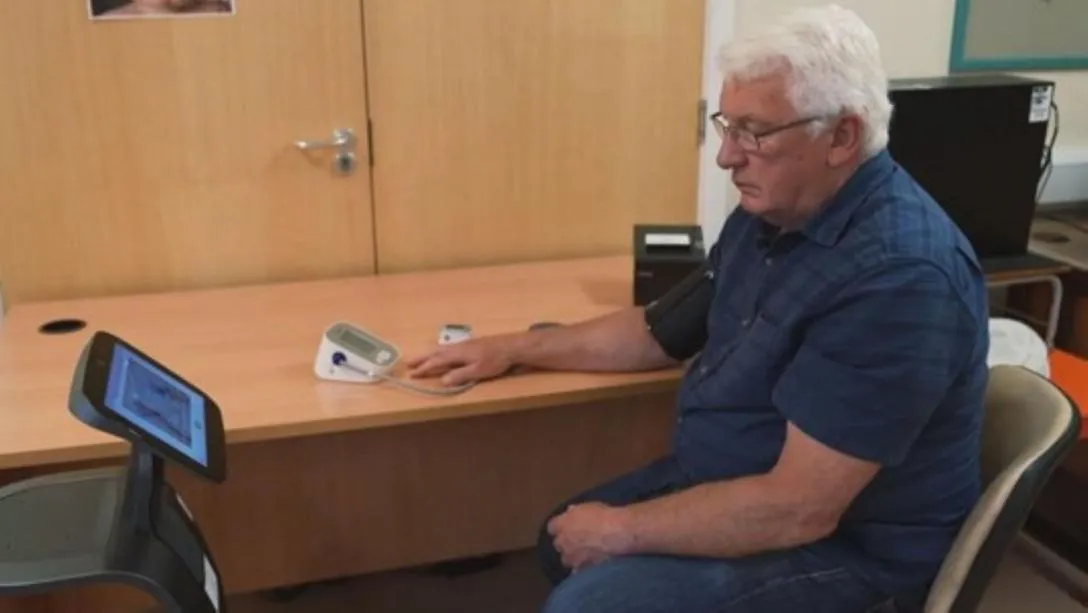
Results were broadly encouraging, with both patients and healthcare staff agreeing the technology had the potential to improve clinic efficiency and reduce the time spent on routine data collection. Accuracy was ranked the top priority by participants, followed by ease of use. The robot’s calm, unrushed communication style and natural language capabilities were highlighted as particular strengths.
Ged Cashley (71), from Dundee, attended the HEART-POD workshop at Erskine Practice. He said:
“In 2018 I had a cardiac arrest and had a defibrillator fitted. Since then, cardiovascular health checks have been a regular part of my life, every three months. I worked in the NHS myself for 34 years before retiring, so I know how appointments work. The first part of almost every patient consultation is spent collecting basic information. That little robot does that job - so by the time you sit down with your GP, they already have what they need and can spend their time actually talking to you.
“What surprised me was that because it's a machine rather than a person, I just answered the questions honestly, without any social pressure. I think that's something a lot of patients would find easier than they expect. I'm already checking in at my GP surgery on a screen, ordering my medication online, and having my device monitored remotely overnight. This is just a good extension of that and one that saves the patient time and gives the doctor more of it. My advice to other NHS patients would simply be to give it a go.”
The British Heart Foundation estimates that more than 800,000 people in Scotland are living with cardiovascular disease. Annual health reviews for patients on the cardiovascular disease register are a critical tool in managing that burden, but place considerable demand on already stretched primary care services.

Drs Gillian Chin (Project Lead) and Trisha Chin (Project Operation Lead), General Practitioners, NHS Tayside. They said:
“As frontline GPs, we recognise that technological advancements such as robotics can have a huge impact for our patients. This innovative collaboration with the Robotarium demonstrates that NHS Tayside can be a fantastic real-world testbed for new ideas, with a supportive network of clinicians and experts, great access to world-class institutions, and a forward-thinking culture. The best thing about running these workshops is having the chance for patients, professionals and specialists to be in the same room, sharing ideas and pushing the product design to a whole other level, while putting users at the centre of these decisions.”
The research also identified practical challenges to address ahead of wider deployment, including microphone performance in clinical environments and participant preferences around privacy.
Dr Mauro Dragone, Associate Professor in Human-Robot Interaction at Heriot-Watt University, co-led the study. He said:
“This trial gave us the opportunity to test the prototype where it actually needs to work - in a busy GP surgery, with real patients. The feedback on speech recognition and privacy preferences is exactly the kind of insight you can only gather in a real clinical environment, and it directly shapes what we develop next. We are confident these are solvable engineering challenges, and the overall response from participants gives us a strong foundation to build on.”
Dr Cristina Tealdi, Professor of Economics, Edinburgh Business School co-led the study. She said: “A key contribution of Edinburgh Business School was to bring an economic and cost–benefit perspective to the project, ensuring that the value of the technology was considered not only in terms of technical performance, clinical utility and user experience, but also in terms of its potential to deliver efficiencies for the NHS. This interdisciplinary dimension was one of the project’s core strengths, complementing the work on robotics and clinical implementation as well as patient involvement and engagement.”
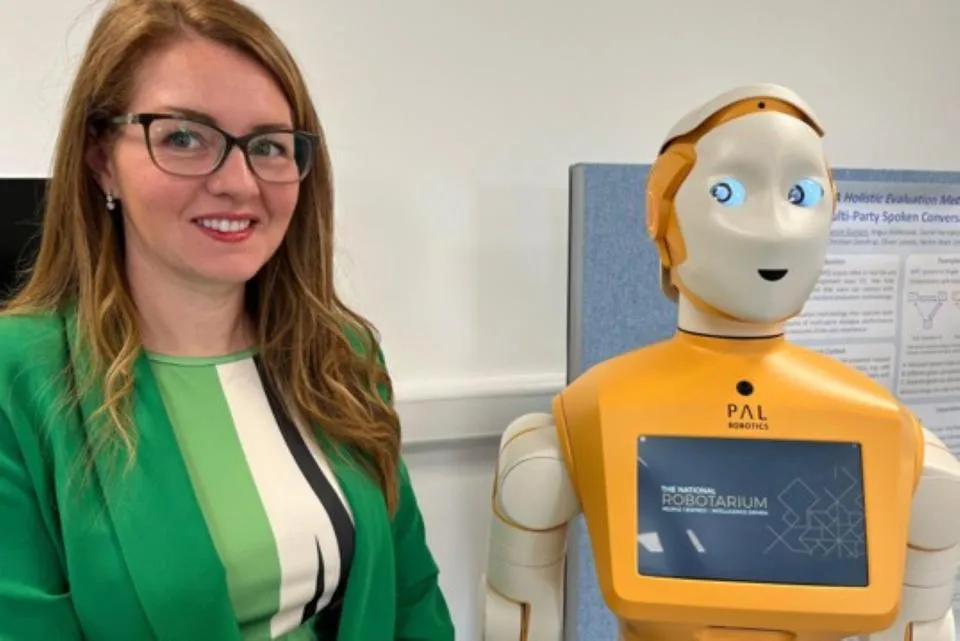
Lisa Farrell, Business Development Manager and lead for healthcare robotics at the National Robotarium, said:
“Annual cardiovascular reviews are a significant demand on primary care, and this project demonstrates that robotics can play a genuine role in managing that workload without compromising the quality of patient experience. The NHS is under real pressure to do more with less, and technologies like this - built around the practical realities of clinical settings - are exactly where investment should be focused.”
Dr Ronnie Smith, Senior Robotics Engineer at the National Robotarium, said:
“Getting a mobile robot to reliably connect to multiple Bluetooth medical devices, process natural language responses, and guide a patient through a clinical assessment autonomously is not a trivial engineering problem. The fact that we were able to field-test a working prototype in a real GP surgery after four months of development is a significant step. It shows that with the right partnerships and the right appetite, robotics can move from research into real NHS settings faster than people might expect.”
The National Robotarium is the UK’s centre for robotics and AI at Heriot-Watt University. The HEART-POD project forms part of the facility’s broader programme of work applying robotics and AI to healthcare challenges. The research findings will inform the next stage of prototype development, with the project team now exploring how the technology can be refined for practical implementation within NHS primary care pathways.
Image credit: BBC Scotland, Ben Glasgow Photography
Contact
Louise Jack
Related content
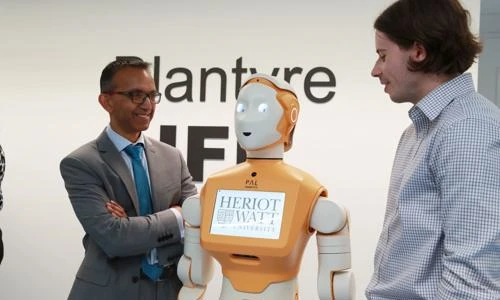
The National Robotarium and Blantyre LIFE: The future of robotics-assisted care
The National Robotarium and Blantyre LIFE are working together to advance development of the next generation of assistive robotics for the health and social care sector.

National Robotarium research centre commended in Scottish Parliament debate
The National Robotarium was lauded as the ‘gold standard' in a Scottish Parliament debate on the future of robotics technology in Scotland and the UK.
Deputy First Minister announces new £5m funding package for Scotland at the National Robotarium
The National Robotarium hosted Deputy First Minister and Cabinet Secretary for the Economy, Kate Forbes MSP, as she announced £5m funding for Scottish start-ups
'World's most advanced' humanoid robot arrives at the National Robotarium
The National Robotarium, Heriot-Watt's centre for robotics and AI, is the first place in the UK to install Ameca, the ‘world's most advanced' humanoid robot.