Restoration Forth wins STEM Research Project of the Year
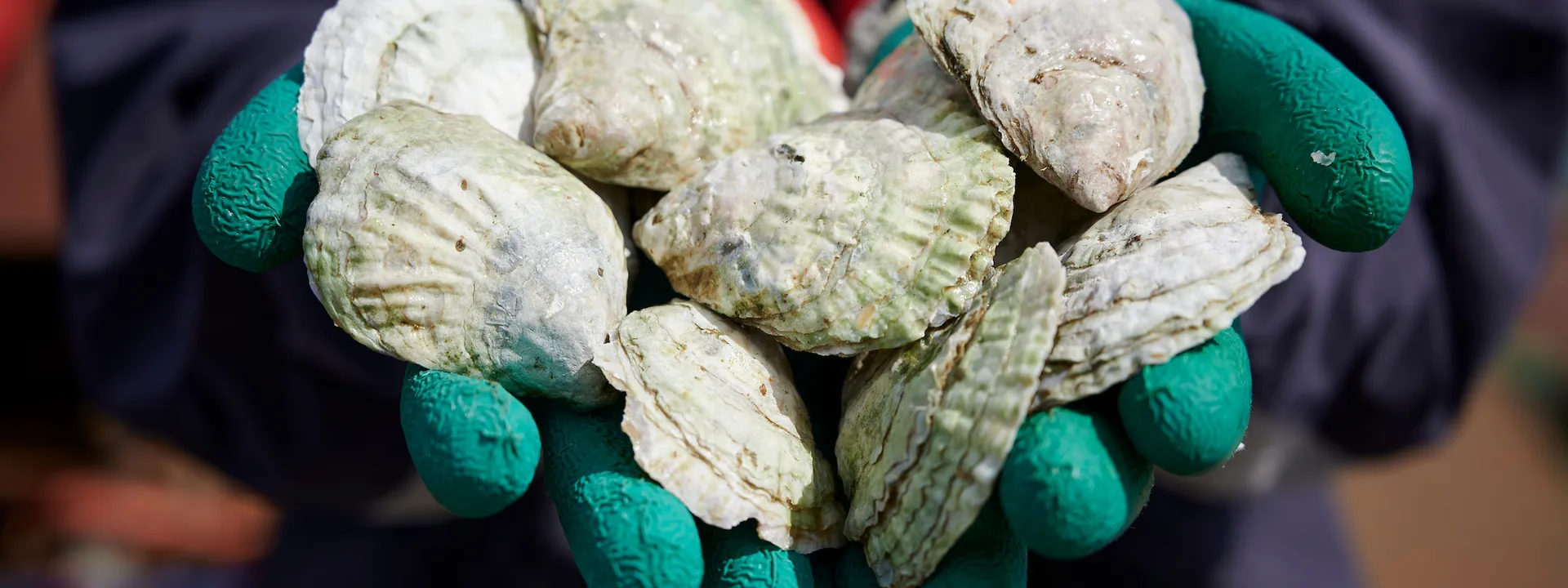
Heriot-Watt University and partners have won the prestigious Research Project of the Year: STEM at Times Higher Education Awards, for Restoration Forth, the pioneering programme restoring European flat oysters and seagrass to the Firth of Forth.
The award recognises the project's powerful combination of world-leading research, strong community partnership and environmental impact.
Since its launch in 2022, Restoration Forth has returned more than 60,000 oysters to the Firth of Forth and achieved some of the highest survival rates on record. It has delivered impressive results and brought hopeful news for Scotland’s seas, where oysters play a vital role in marine ecosystems.
"I'm delighted that we have received this prestigious recognition of our work. Founded on more than a decade of meticulous Heriot-Watt oyster restoration research, Restoration Forth has repeatedly smashed its restoration targets. None of this is possible without the massive contribution of Dr Naomi Kennon, Emmy Cooper-Young, an army of amazing volunteers, and our stead-fast partners, not least WWF and the Marine Conservation Society.”
Professor Bill Sanderson
The Times Higher Education award is a recognition of these outstanding achievements in marine restoration and environmental recovery. Professor at Heriot-Watt's School of Energy, Geoscience, Infrastructure and Society Bill Sanderson attended the ceremony Thursday evening and accepted the Research Project of the Year Award alongside Associate Executive Dean for Research and Impact, Professor Teresa Fernandes.
Professor Sanderson, who leads the scientific support for oyster restoration in Restoration Forth, said: “I'm delighted that we have received this prestigious recognition of our work. Founded on more than a decade of meticulous Heriot-Watt oyster restoration research, Restoration Forth has repeatedly smashed its restoration targets. None of this is possible without the massive contribution of Dr Naomi Kennon, Emmy Cooper-Young, an army of amazing volunteers, and our stead-fast partners, not least WWF and the Marine Conservation Society.”
At their peak, the oyster beds of the Firth of Forth yielded up to 30 million oysters a year. But, by the beginning of the twentieth century, overfishing had reduced them to local extinction.
Restoration Forth is helping to reverse that loss. Oysters filter water, store carbon and create habitat for other marine species, while restored seagrass meadows support healthier, more resilient coastal ecosystems.
“This award is fantastic recognition of everyone involved in Restoration Forth. By bringing together researchers with partners and local communities, the project has helped return native oysters to the Firth of Forth for the first time in more than 100 years. It is a brilliant example of research delivering real-world impact, and proof that through collaboration, innovation and determination, what has been lost can be brought back.”
Professor Chris Turney
Deputy Principal for Research and Innovation at Heriot-Watt University
Professor Chris Turney, Deputy Principal for Research and Innovation at Heriot-Watt University, said: “This award is fantastic recognition of everyone involved in Restoration Forth. By bringing together researchers with partners and local communities, the project has helped return native oysters to the Firth of Forth for the first time in more than 100 years. It is a brilliant example of research delivering real-world impact, and proof that through collaboration, innovation and determination, what has been lost can be brought back.”
This award is a testament to the outstanding work of Heriot-Watt and a range of partners including Marine Conservation Society, Project Seagrass, Balanced Horizon, Royal Botanic Garden Edinburgh, Scottish Seabird Centre, coordinated by WWF.
Director at WWF Scotland, Lang Banks, said: “We’re delighted that Restoration Forth has won this award in recognition of the impact that can be made when we work across academia, civil society and local communities to bring nature back to life.”
While Restoration Forth is making waves in marine restoration, it is also helping more people feel connected to and responsible for the future health of the Firth of Forth. From biodiversity surveys at deployment sites to assisting with monitoring of oyster survivability and growth in intertidal experiments, citizen scientists have been at the core of the project’s success: over 700 volunteers were engaged across 37 events generating habitat data integrated into site suitability models.
The project's next oyster phase includes a dedicated hatchery at North Berwick run by Balanced Horizons, developed with Heriot-Watt's academic support. The hatchery will supply oysters at the volume needed to move from a proof-of-concept restoration into something approaching the ecosystem scale that the original Forth beds once represented. Hundreds of thousands of oysters, eventually millions, is the ambition.
How to watch this YouTube video
We couldn't detect your cookie choices so can't show this video here. You can watch on YouTube below.
Contact
Media Enquiries
Related content
Oysters booming in Firth of Forth
European flat oysters returned to the Firth of Forth as part of a major restoration project are showing signs of loving their new home.
Native oyster populations return to Firth of Forth after 100 year absence
For the first time in 100 years, native oysters have been returned to the Firth of Forth as part of the groundbreaking “Restoration Forth” project.

First oysters born in Dornoch Firth for over 100 years
Native oysters have been born in the Dornoch Firth for the first time in more than 100 years, marking a major milestone in a landmark restoration project.