Ocean microplastics carry a “memory” of their journey, mathematics reveals
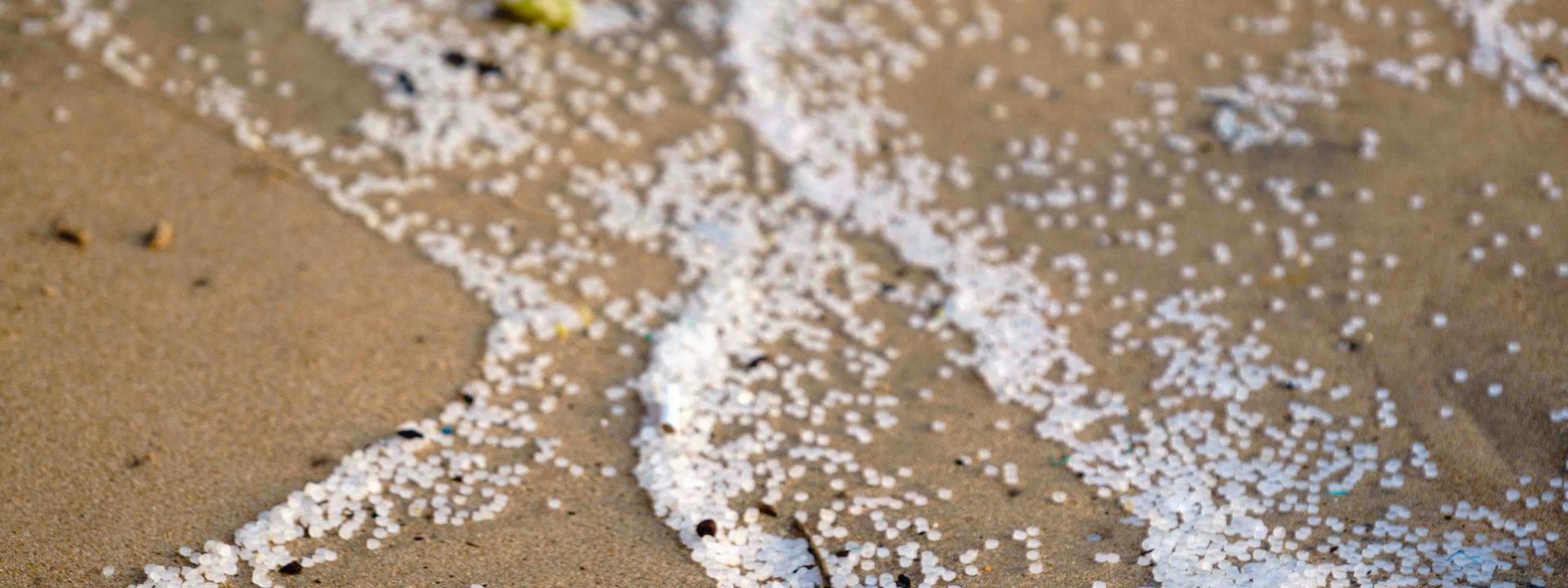
Researchers have discovered that microplastic particles retain a “memory” of their previous movement, influencing how they travel through the world’s oceans and paving the way for more accurate predictions of where marine plastic pollution ends up.
Rather than responding only to the waves around them at any given moment, the earlier motion of larger microplastic particles influences where they travel.
Published in Physics of Fluids, the study from Heriot-Watt University identifies the conditions under which this effect becomes large enough to significantly affect predictions of how far microplastic particles are transported by ocean waves.
By accounting for these memory effects, we can develop more reliable mathematical models that help scientists better predict the movement of marine plastic pollution. Better predictions will ultimately support environmental monitoring, risk assessment and future strategies to protect marine ecosystems.
Dr Cathal Cummins
Associate Professor in the School of Mathematical and Computer Sciences at Heriot-Watt University
The findings could help scientists build more accurate models of how marine plastic pollution spreads, supporting future efforts to understand its environmental impact and inform strategies to monitor and manage plastic pollution.
Researchers from Heriot-Watt’s School of Mathematical and Computer Sciences used a mathematical model that captures this effect efficiently, which is usually left out of ocean transport models because it is so computationally demanding to include.
Current models often assume that the forces acting on microplastics depend only on their immediate surroundings.
This can be true for very small microplastic particles. However, the new research demonstrates that, for many larger microplastic particles, previous interactions with ocean waves continue to shape their movement over time.
The research, which was a feature pick in the journal, identifies the point at which these “memory effects” become significant, providing scientists with practical guidance on when they should be included in future models of microplastic transport.
Dr Cathal Cummins, Associate Professor in the School of Mathematical and Computer Sciences at Heriot-Watt University leads the Contraflow research group. He said:
“Plastic pollution is one of the defining environmental challenges of our time, but we still do not fully understand how microplastics move through the ocean or where they ultimately end up.
“Our work shows that larger microplastic particles effectively carry a memory of their previous motion through the water. That memory changes how they respond to waves and can have a significant impact on how far they travel.
“By accounting for these memory effects, we can develop more reliable mathematical models that help scientists better predict the movement of marine plastic pollution. Better predictions will ultimately support environmental monitoring, risk assessment and future strategies to protect marine ecosystems.”
Microplastics, defined as plastic particles smaller than five millimetres, are created as larger pieces of plastic break down over time. They have been found throughout the world’s oceans, from coastal waters to the deep sea.
The new model incorporates a physical phenomenon known as the Basset-Boussinesq history force, which describes how a particle’s previous motion continues to influence its future behaviour. While this effect has been recognised for well over a century in fluid dynamics, it has largely been excluded from models of ocean microplastic transport because of the significant challenges involved in computing it.
Using an efficient numerical approach, the Heriot-Watt team was able to include these memory effects in simulations of wave-transported microplastics across a wide range of particle sizes. Their results showed that memory effects become important at much smaller particle sizes than scientists had previously estimated.
Mary Eby, PhD researcher in the School of Mathematical and Computer Sciences at Heriot-Watt University, said:
"Our aim was to identify how small microplastic particles must be to justify the omission of memory effects in mathematical models. We found that this threshold occurs for much smaller microplastic particles than previously thought, giving researchers clearer guidance on when these effects need to be considered. This should help future studies build a more complete picture of how microplastics are transported through the ocean and provide additional context for past studies in the existing literature."
Beyond improving understanding of marine plastic pollution, the researchers believe the mathematical techniques developed could also have wider applications wherever particles move through complex fluids, including environmental engineering, industrial processes and other areas of fluid mechanics.
The research was carried out by Dr Cathal Cummins and Mary Eby from Heriot-Watt University’s School of Mathematical and Computer Sciences and Institute for Sustainable Built Environment.
More information on the research group can be found here.