New study reveals how marathon runners could beat the two-hour time barrier
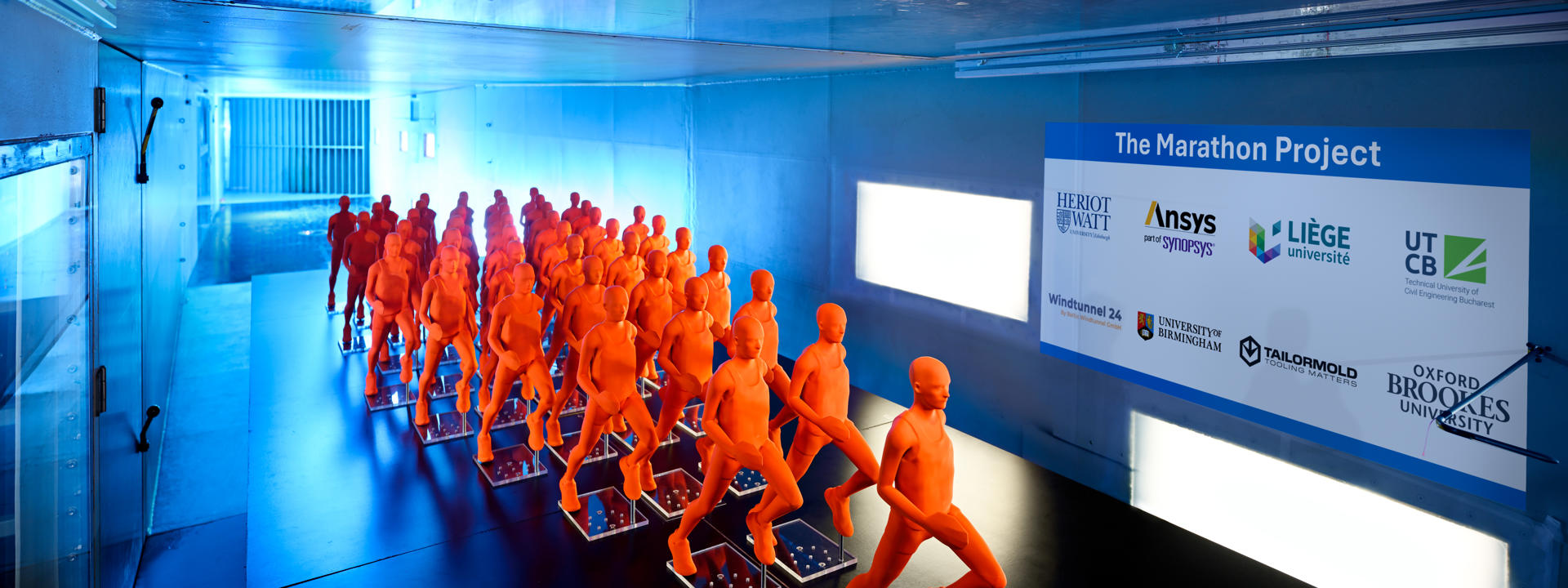
A new aerodynamic study investigating how running formations and airflow impacts runners has suggested elite athletes could significantly cut race times and challenge the two‑hour marathon barrier.
Researchers at Heriot‑Watt University, working with Synopsys, a leading engineering solutions company, used cutting‑edge aerospace simulation software to show how certain tactics could help elite marathon runners shave up to 40 seconds off their race times.
The study challenges the long-held belief that aerodynamics only matter at high speeds, showing that airflow management can conserve energy for long-distance running.
Aerodynamics has long been underestimated in running, but our simulations show it plays a significant role. The right running formations can sharply reduce air resistance, conserve energy and, under the right conditions, help athletes push towards record-breaking performances for marathon running.
Bert Blocken
Project lead, Professor of Aerospace Engineering (Aerodynamics) at Heriot-Watt University’s School of Engineering and Physical Sciences
At the elite level, marathon performances are often decided by seconds rather than minutes, making even small efficiency gains potentially decisive in record‑level competition.
Project lead, Professor Bert Blocken, Professor of Aerospace Engineering (Aerodynamics) at Heriot-Watt University’s School of Engineering and Physical Sciences said: “We cannot replicate every race condition precisely.
"But what we can do is clearly demonstrate which aerodynamic strategies provide the greatest benefit, and how athletes can position themselves to conserve energy and maximise performance over long distances.
“Aerodynamics has long been underestimated in running, but our simulations show it plays a significant role. The right running formations can sharply reduce air resistance, conserve energy and, under the right conditions, help athletes push towards record-breaking performances for marathon running.”
To carry out the study, the team used advanced computer simulations to analyse how air moves around runners during a marathon.
Using Ansys Discovery software, researchers created detailed digital models of runners, before applying Ansys Fluent software to simulate airflow and measure aerodynamic drag.
These simulations were validated using wind tunnel testing to ensure the results reflected real‑world racing conditions.
The research is believed to be the first to simulate and experimentally validate the aerodynamics of marathon running groups of up to 45 athletes.
Using Synopsys’ software, the team, with HWU researchers Prof. Bert Blocken, Dr Fabio Malizia and Dr Xiaoqi Hu, analysed more than 24 different pack formations, including changes in spacing, alignment and mixed male and female groups.
The results show that a runner’s position within a group plays a crucial role in reducing air resistance, with the greatest benefits seen in well‑organised packs.
Interestingly, three days after the first public release of the study, athlete Sabastian Sawe broke the 2-hour world record in the London Marathon, indeed achieved by intensive drafting throughout a large part of the race.
The findings also have implications beyond elite competition. The research suggests recreational runners could benefit from avoiding running alone, staying in packs for longer and running single file rather than side by side, helping to conserve energy over long distances.
Thierry Marchal, Industry Director for Sports, Synopsys said: “Advanced simulation analysis is revolutionising all industries from aerospace to healthcare, and we’re now seeing how it is transforming performance sports.
“Using aerodynamic drag analysis software originally designed for aviation and automotive, we’re able to quantify performance effects that are impossible to measure at scale in real marathon races.
“By combining air resistance simulations with wind tunnel validation, this study shows how drafting and formation strategy can translate complex physics into real world performance gains for athletes.
We’re excited to be working on these studies with Heriot-Watt University, in addition to other leading researchers around the world.”
By running in the right position within a group, athletes could reduce aerodynamic drag by up to 90 per cent compared to running alone.
Even more surprisingly, the research shows that runners at the front of a pack can also gain aerodynamic benefits from those running behind them.
Closely following runners help push air forward, reducing resistance on the lead athlete, a dynamic well known in cycling but previously underestimated in long‑distance running.
Depending on positioning, drafting behind just one other runner could save around 20 to 30 seconds over the course of a marathon.
When combined with other aerodynamic optimisations, total time savings could approach 30 to 40 seconds in realistic race conditions, margins that could prove decisive at the elite level.
The full study can be read here: https://tinyurl.com/zjd98dy5