New AI research aims to make quantum sensors faster and more precise
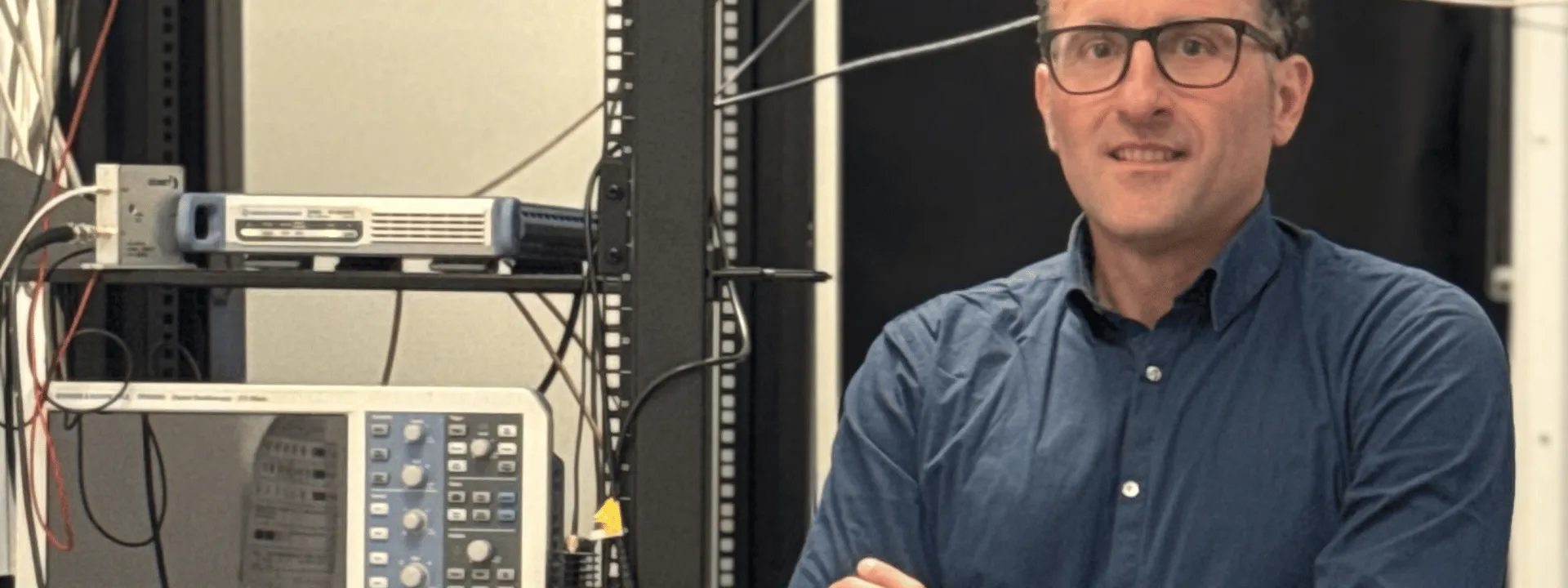
A prestigious UK research fellowship will investigate how artificial intelligence can make quantum sensors faster and more precise, with potential applications in healthcare and secure communications.
Professor Cristian Bonato’s work is exactly the kind of ambitious, forward-looking research that will help keep Scotland and the UK at the forefront of quantum innovation.
Professor Steve McLaughlin
Vice-Principal and Provost of Heriot-Watt University
Professor Cristian Bonato, from Heriot-Watt University, is one of 20 researchers selected to share more than £39 million of Turing AI funding from UK Research and Innovation (UKRI).
Professor Bonato’s three-year project will focus on developing an AI system capable of deciding which measurements to take during quantum experiments, learning from the results and adapting its approach in real time.
By focusing on the measurements that retrieve the most information and neglecting the less valuable ones, the system can greatly speed up the operation of quantum sensors.
Quantum sensors use single quantum particles, such as a single electron, at the smallest scales to detect extremely weak signals, for example from single molecules. They have the potential to reveal information that conventional technologies struggle to measure, but experiments can be slow and interpreting the results is often challenging.
Professor Bonato from Heriot-Watt University’s School of Engineering and Physical Sciences said: “Quantum sensors are incredibly powerful tools, but extracting useful information from them can be a slow and demanding process. We want to develop an AI system that can make decisions as an experiment unfolds. It will learn from each measurement, work out what information is still missing and decide what to investigate next.
“This could allow us to carry out experiments much more efficiently and explore quantum systems that are currently extremely difficult to understand.”
Researchers usually analyse measurements after an experiment has finished, then decide what to test next and carry out further measurements. The new system will instead work directly with the sensor, adjusting the experiment as new information becomes available.
It will also be designed to recognise when the same results could have more than one scientific explanation. It could then select a different measurement to help establish which explanation best describes what is happening, giving researchers a clearer understanding of the quantum particles they are studying.
The research will also explore how AI can help scientists achieve greater control over individual electrons and atomic nuclei. Once the AI has learned more about how these particles behave, it will work out how to manipulate them with greater precision. This is an important step towards quantum memories, which use single quantum particles to store quantum information and are key building blocks for future secure quantum communication networks.
Professor Bonato added: “The potential applications of this work are particularly exciting. In healthcare, improved quantum sensors could help us investigate biological processes at a scale that is currently difficult to access. There are also major opportunities in quantum communications, where being able to identify and precisely control individual particles could help us build more reliable quantum memories.
“Ultimately, we hope this research will establish a new way of conducting scientific experiments, where AI can help researchers explore complex questions and make discoveries more quickly.”
Professor Steve McLaughlin, Vice-Principal and Provost of Heriot-Watt University and mentor on the project, said: “Heriot-Watt has major strengths in quantum networking, sensing and materials, and as a partner in four of the UK’s five national quantum hubs, we are helping to shape where this field goes next. Professor Bonato’s work brings AI into the experiment itself, which has the potential to accelerate how quickly quantum technologies move from the laboratory into real-world use. It is exactly the kind of ambitious, forward-looking research that will help keep Scotland and the UK at the forefront of quantum innovation.”
The project, titled Developing A Real-time AI-Enhanced Experimenter For Quantum Sensing, aligns with two major UK quantum research programmes focused on integrated quantum networks and quantum sensing for biomedical applications.
Professor Bonato’s award is one of 17 Turing AI Pioneer Interdisciplinary Fellowships, which support researchers in other scientific fields to use AI to make new discoveries.
The remaining three fellowships in the round are Turing AI Global Fellowships, intended to attract leading AI researchers to the UK. The programme is delivered by the Engineering and Physical Sciences Research Council (EPSRC) and supports the UK Government’s ambition to strengthen national AI research capability.
Professor Charlotte Deane, Executive Chair of EPSRC, said: “AI has enormous potential to transform the way we understand and tackle some of the biggest challenges facing society. These fellowships will give outstanding researchers the freedom and support to push the boundaries of AI itself, while also applying it in new ways across a wide range of disciplines.”