Groundbreaking study in light control opens door to new technological frontiers
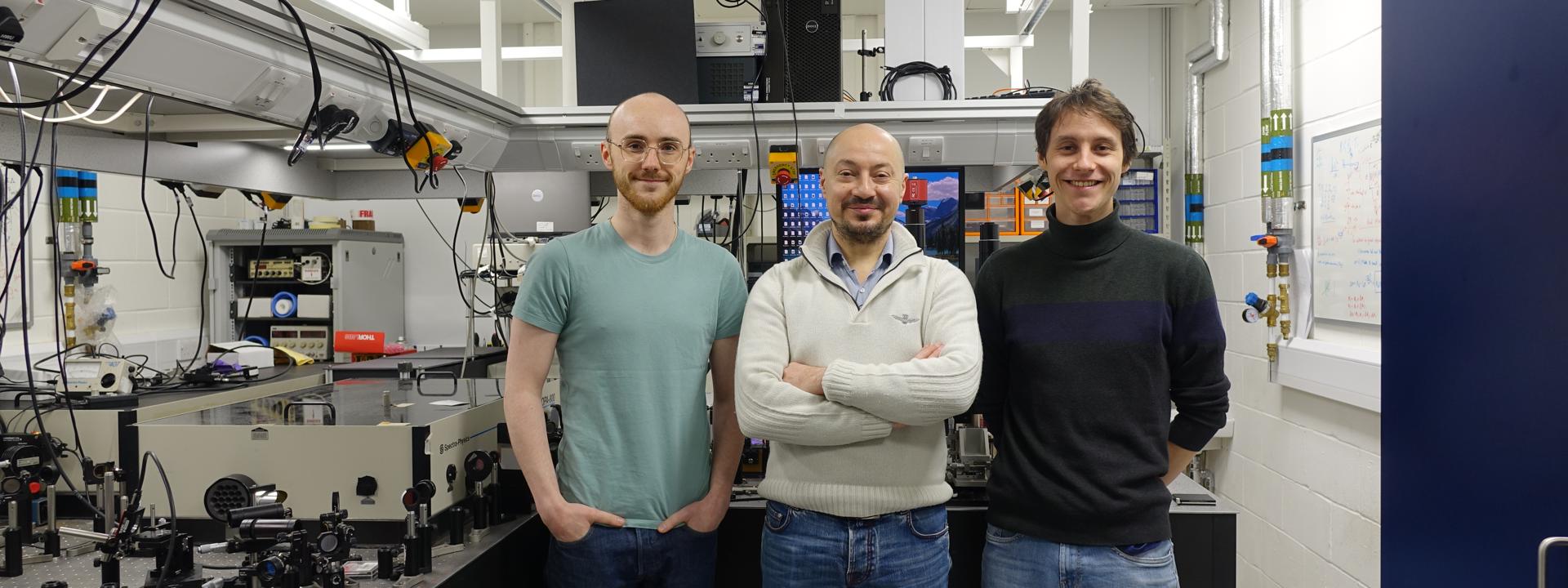
Scientists at Heriot‑Watt University have demonstrated in a world-first, that light can be used to control every aspect of how electromagnetic waves oscillate, opening new technological frontiers.
Researchers working in photonics, the science of light, have discovered a new way to control “polarisation” a key property of light that plays a crucial role in the performance of technologies such as drug development and quantum computers.
This now opens up entirely new possibilities for future medical tools and next‑generation quantum technologies which have been held back by this limitation previously.
Marcello Ferrera
Professor at Heriot-Watt University’s School of Engineering and Physical Sciences
The breakthrough resolves a long-standing challenge in photonics: achieving control of light that is both fast and strong enough to be useful in real systems
The research, titled: All-optical polarization control in time-varying low index films via plasma symmetry breaking, has been published in leading global research journal Nature Photonics.
Dr Marcello Ferrera, Professor at Heriot-Watt University’s School of Engineering and Physical Sciences, said: “How light oscillates has a huge impact on how it interacts with the physical world around us. For the first time, we now have full control over this property of light, for any polarisation state, and at ultra‑fast speeds.
“This matters because controlling how light oscillates gives direct control over how it interacts with matter. For example, light of a given colour can be engineered to be either fully absorbed or fully transmitted by a specific material.
“A simple way to picture this is to think about earthquakes. Some waves compress the ground, while others move it up and down. They are both waves, but their effects, and how they interact with the world, are completely different.
“In the same way, changing the polarisation of light can completely change how it behaves, including how it interacts with materials, carries information, or reveals details that would otherwise be invisible.”
To achieve this level of control, the team designed an experiment where light itself briefly changes the behaviour of a material.
To carry out the experiment, researchers used a very thin, transparent film made from aluminium zinc oxide, a material already widely used in technologies such as touchscreens and solar panels.
On its own, the material behaves like ordinary glass and does not affect light in any special way.
Researchers then shone a very short and ad-hoc engineered burst of light onto the film, lasting less than a trillionth of a second.
During this fleeting moment, a second, carefully timed pulse of light passes through the film and has its behaviour shaped by the first. The initial pulse effectively “programmes” how the second one oscillates, determining how it will interact with other materials.
Professor Ferrera added: “One clear real‑world example of where this matters is medicine. In fact, when synthesising a specific drug, polarised light is used to distinguish between mirror images molecules which have very different chemical reaction to our body.
“Another is in quantum computing. Because quantum technologies encode information in the polarisation of light, this type of ultrafast control has direct implications for faster and more flexible quantum communication systems, including highly secure data transmission.”
Crucially, this was done using only light, with no electronics or moving parts, allowing changes to happen 10,000 time faster than what is possible using state of the art electronics.
The effects achieved were about hundred thousand times stronger than anything previously recorded, becoming another critical milestone in the emerging field known as time‑varying photonics.
Professor Ferrera explains: “Until now, most photonics research has relied on materials that stay the same while light passes through them.
“What makes this different is that the material itself is changing while the light is travelling through it. That may sound subtle, but it fundamentally changes how we can manipulate light.
“For instance, we have direct access to change the energy of photons (the quanta of light). Time‑varying systems have been an interesting theoretical speculation for decades, but now it is finally a reality.
“This now opens up entirely new possibilities for future medical tools and next‑generation quantum technologies which have been held back by this limitation previously.”
The study was led by researchers from Heriot‑Watt University’s Institute of Photonics and Quantum Sciences, within the School of Engineering and Physical Sciences, working with international partners at Purdue University’s Elmore Family School of Electrical and Computer Engineering, the University of Brescia, and the University of L’Aquila.
The experimental research was carried out at Heriot‑Watt University in Edinburgh with funding provided by several national and international funding agencies [EPSRC, STFC (UK), and AFOSR (USA]
To read the full research, published in Nature Photonics please visit: https://www.nature.com/articles/s41566-026-01886-3?utm_source=rct_congratemailt&utm_medium=email&utm_campaign=oa_20260403&utm_content=10.1038/s41566-026-01886-3