From megaprojects to human-centred cities, women are helping shape the UAE’s built environment
Grant Thornton UAE and Heriot-Watt University Dubai have published new research showing that women are playing a bigger role in shaping the UAE's built environment than is often recognised. It points to a shift beyond landmark construction towards more complex and multi-disciplinary projects which require diverse perspectives and broader leadership approaches.
More than a fifth of the UAE economy is directly linked to the built environment, with construction accounting for 12.9 percent of GDP in 2025 and real estate a further 7.4 percent. The UAE is the Gulf's largest construction market by project volume, with 628 active developments worth $138 billion as of mid-2026.
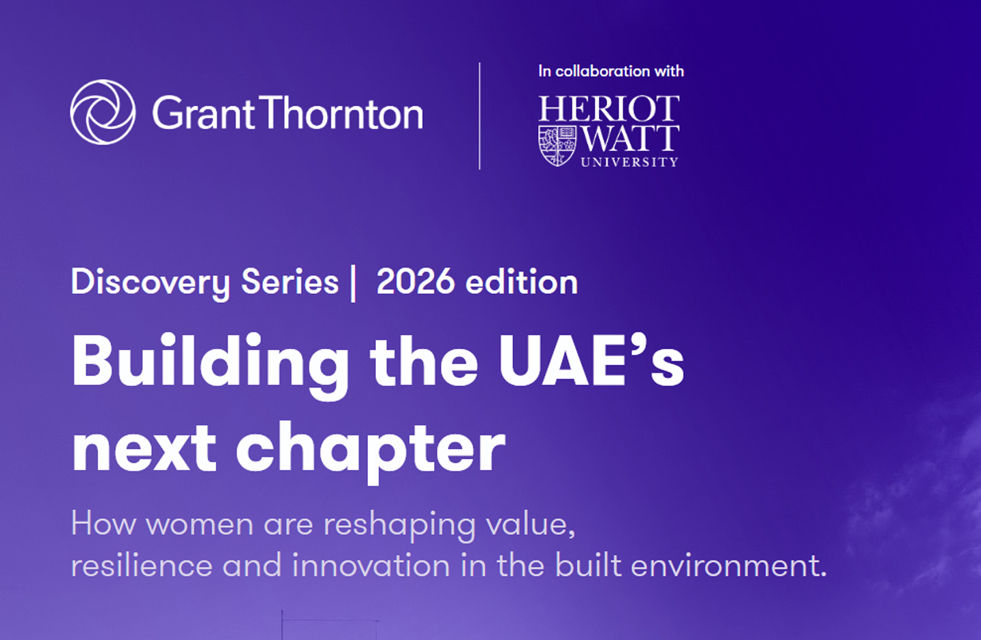
‘Building the UAE’s next chapter. How women are reshaping value, resilience and innovation in the built environment’ is the third edition of the Grant Thornton UAE Discovery Series, following the report into female representation in financial services in 2025. It draws on in-depth interviews with five senior women leaders across construction, technology, architecture, real estate, sustainability advocacy, and education, and profiles a further 20 women who have visibly shaped the country's physical landscape.
The UAE has one of the strongest pipelines of female STEM talent, with women accounting for 56 percent of STEM graduates. The research shows that converting that talent into leadership is still a worldwide challenge.
Professor Dame Heather McGregor, Provost and Vice Principal of Heriot-Watt University Dubai, points to the gap between the talent coming through and the leaders at the top. "The UAE has shown what is possible when policy, education and industry work together," she says. "The talent is there. The opportunity now is to ensure more women are supported to build lasting careers and progress into leadership. As the built environment becomes more complex and skills-intensive, this is more than a question of representation – it is a business imperative."
Women make up around 14 percent of the construction workforce in both the US and the EU, and in the UK almost half of the women who leave the industry do so before the age of 34. Long hours, rigid working patterns and male-dominated cultures are the barriers most often cited.
The UAE has always been ambitious in how it has built for the future. The opportunity now is to be equally ambitious about who shapes that future. The women in this report are already shaping how communities are designed, how technology is adopted and how future talent is developed. By making their leadership more visible and widening the path for others to lead, we can build a sector that is more innovative, resilient and ready for what comes next.
Hisham Farouk
CEO of Grant Thornton UAE
A key theme emerging from the report is the importance of creating liveable, sustainable communities built around human needs.
The leaders interviewed agreed that technologies such as artificial intelligence will play an important role in the future of the sector. However, they see AI as a tool that enhances human judgement, creativity and expertise rather than replacing it.
AI is already being used to measure emissions, improve legacy data and support design and construction processes, but people will remain central to decision-making.
Voices Behind the Research
The report features interviews with five influential women leaders from across the built environment sector:
- Dr Habiba Al Mar'ashi, Co-founder and Board Member, Emirates Green Building Council
- Mireille Azzam-Vidjen, Executive Director and Head of Strategic Consulting Middle East and Africa, JLL
- Dr Harpreet Seth, Head of Architecture and Associate Professor, Heriot-Watt University Dubai
- Leila Sobek, Founder and Director, BMA Studio
- Dr Sonia Zahiroddiny, Chief Information Officer, Innovo Group
In addition, the research profiles 20 women whose work has helped shape the UAE's physical landscape and urban development.
Looking Ahead
The report paints a picture of a sector undergoing significant transformation. While iconic buildings remain a symbol of the UAE's success, the future of the built environment will increasingly be defined by sustainable communities, technological innovation and diverse leadership.
As the UAE continues to grow, the research suggests that empowering more women to step into leadership roles could be one of the foundations of the country's next chapter.