Driverless cars and digital twins need more than 5G, TransiT researchers find
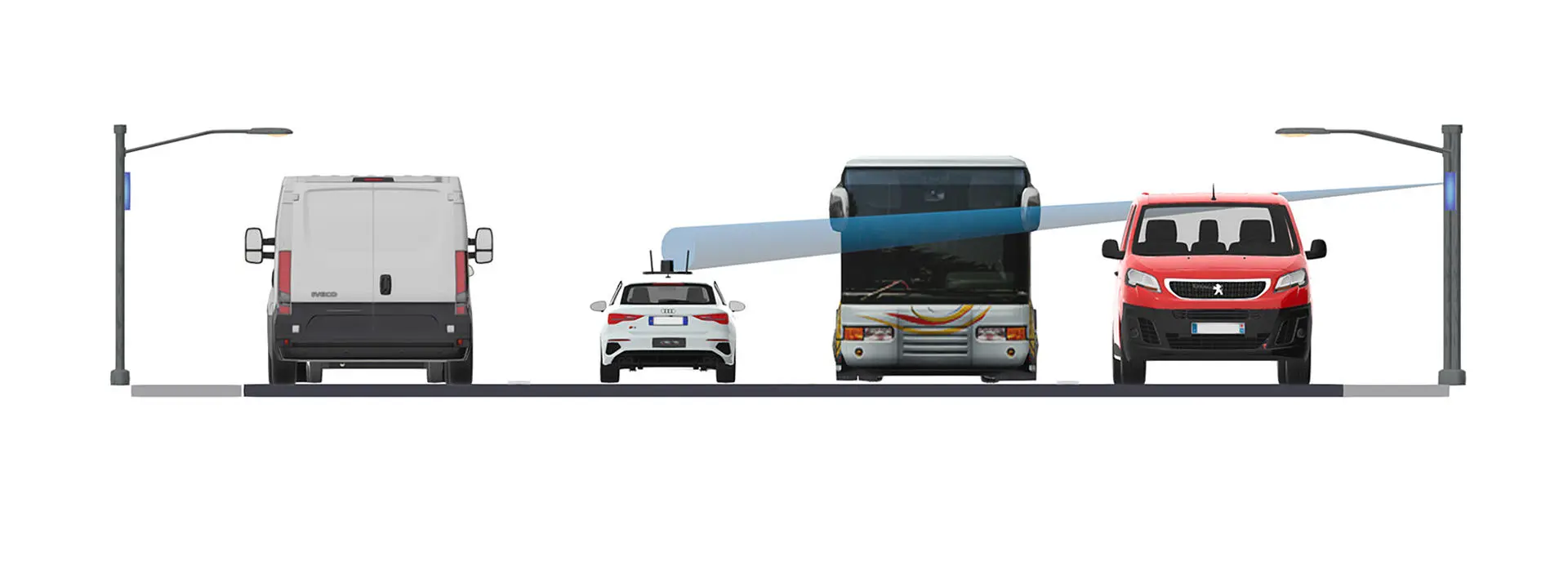
Everyday traffic including cars and trucks can seriously disrupt the 5G signals needed to run future ‘intelligent’ transport systems, new research finds.
The work highlights major challenges to the operation of driverless vehicles and also digital twins – digital replicas of objects, processes or systems in the physical world that are increasingly being used to improve the efficiency and sustainability of transport through functions including predictive maintenance and route optimisation.
Researchers at the University of Glasgow and Heriot-Watt University in Edinburgh conducted the study for TransiT, a national UK research hub using digital twins to identify the fastest, lowest-cost pathways to transport decarbonisation in the UK.
5G is the world’s fifth generation wireless technology, with faster speeds and higher data-carrying capacity critical to advances like ‘intelligent transport systems’ – where vehicles exchange data with each other and with infrastructure like roads and traffic signals to improve the safety, efficiency and sustainability of transport.
Dr Mohammad Al-Quraan, a Research Associate in Autonomous Systems & Connectivity at the University of Glasgow, explained: “Driverless vehicles and digital twins both rely on ultra-reliable, uninterrupted communication systems that can transmit data at high speed and in real time – like ‘5G and beyond’ technologies.
“These are needed to ensure that driverless vehicles are continuously connected to the operations centres controlling them, and that digital twins can exchange decisions instantly – or in near to real time – with their physical counterparts in the real world.
“But our research shows that even next-generation communication technologies like 5G are vulnerable to blockages from obstacles like vehicles and pedestrians – which highlights the need for new innovations in this area.”

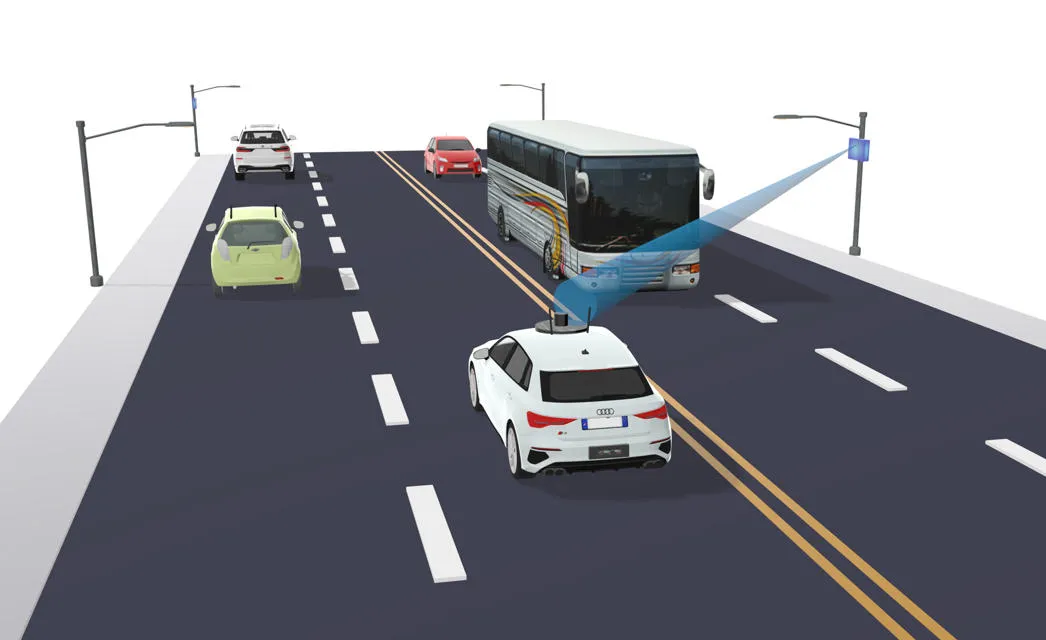
To understand how traffic affects 5G performance, the team built a detailed simulation of a 160 metre stretch of urban road representing a typical two-lane dual carriageway.
This included driverless ‘Connected and Autonomous Vehicles’ (CAVs), which use sensors including cameras and radar to monitor their surroundings and send a continuous flow of high resolution data to their control centres, using high-speed two-directional communication links.
The researchers also modelled conventional cars, vans, trucks and buses, driving at realistic traffic speeds of between 10 to 70 miles per hour. They then tested how 5G signal performance would be impacted by three different scenarios. The first of these was traffic congestion at three different levels: low, medium and high. The researchers also tested how signal quality would be affected by increasing both the number and height of roadside units – 5G radio units mounted on lampposts – along each side of the road.
These 5G signals are very sensitive and even a car passing in front of them can cause a huge loss.
Dr Mohammad Al-Quraan
TransiT researcher and Research Associate in Autonomous Systems & Connectivity at the University of Glasgow
The results show that heavier traffic leads to more frequent blockages and weaker signals. Under high congestion, the main 5G link dropped in signal strength by about 20% compared to light traffic.
The researchers say this could cause delays in sending sensor data or even force vehicles to fall back to slower 4G networks.
The team also found that raising the height of roadside 5G units can reduce blockages. At around 11 metres, all blockages disappeared in their tests. But placing antennas too high can weaken the signal due to distance, so planners must balance height with performance. “While a higher placement can reduce blockage occurrences, it must be balanced against the potential negative impact on signal strength,” the authors write.
Adding more roadside units helped in some cases, but not always. In very busy traffic, extra units sometimes increased the chance of both main and backup links being blocked at the same time. This suggests that simply installing more 5G equipment is not enough; smarter planning and coordination are needed.
Dr Al-Quraan said: “These 5G signals are very sensitive and even a car passing in front of them can cause a huge loss.
“Our research highlights the need for resilient communication systems that can predict and avoid blockages like these, so autonomous vehicles and digital twins have the connectivity they need to operate in our future decarbonised transport networks.”
The researchers hope their work will provide “valuable insights” for network operators and system designers building the next generation of intelligent, low carbon transport networks.
They said leveraging artificial intelligence may help predict signal disruptions and enable 5G and future networks to maintain the “seamless, uninterrupted communication,” which is essential for time-sensitive applications.
Dr Al-Quraan will present a paper on the research this May in Glasgow at The 2026 IEEE International Conference on Communications (ICC), one of the most important annual events in the telecommunications and networking industry.
The co-authors of the research are part of TransiT’s team at the University of Glasgow and Heriot-Watt University in Edinburgh and are Runze Cheng, Stefanos Evripidou, Xicheng Li, Philip Greening, David Flynn, Muhammad Ali Imran, Dimitrios Pezaros and Ahmad Taha.
TransiT is a collaboration of eight universities and almost 70 industry partners, jointly led by Heriot-Watt and the University of Glasgow and funded by the UK Research and Innovation Engineering and Physical Sciences Research Council, the main funding body for engineering and physical sciences research in the UK.