Charging needs for trucks in Scotland
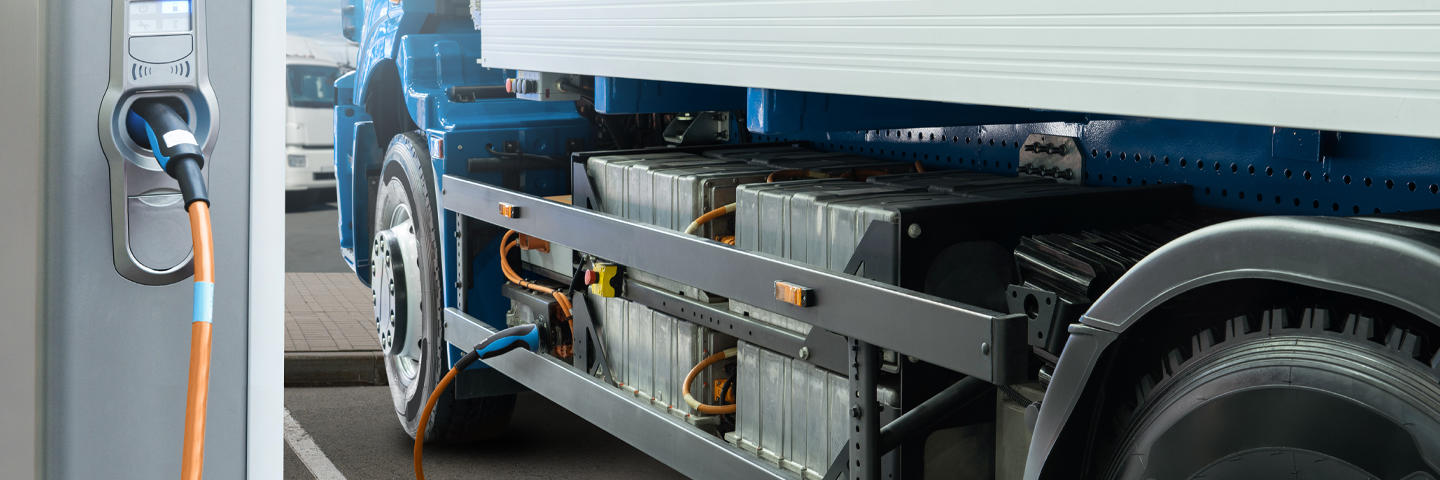
Test drive our ScotVolt zero emission road transport tool
ScotVolt zero emission road transport toolWhat is ScotVolt?
ScotVolt is an interactive dashboard to explore what happens when Scotland's heavy goods vehicles (HGVs) switch from diesel to electric.
We welcome anyone interested in zero emission toad transport to test this tool and send us their feedback, using the email contacts below.
Our tool uses simulation data to show where chargers would be needed, how much electricity they would draw, and whether the local electricity grid can handle it.
It covers 56 scenarios (combinations of vehicle efficiency, battery size, charger power, and network coverage) across summer and winter seasons, using around 2% of Scotland's HGV fleet as a representative sample.
You can use the tool to test:
Routing – Explore the 6 key freight corridors across Scotland. See which charger stops a truck would need on each route, based on vehicle range and charger locations. You can also build custom routes between any two hubs.
Charging – Two side-by-side maps show how many vehicles visit each charger (left) and how much energy they draw from the grid (right). Select a scenario using the sidebar controls, then click any circle for detail.
Bay Sizing – How many physical charging bays does each location need to meet the demand from electric trucks? This part of our simulation shows what charging infrastructure you'd need to build: the minimum number of physical charging bays at each location so that arriving trucks have less than a 5% chance of finding all bays occupied.
Send us your feedback
Once you have tried out the tool, you can share your feedback with us by email to our research team:
Siti Fariya S.Fariya@hw.ac.uk
Dhanan Utomo D.Utomo@hw.ac.uk
Alan Logan Alan.Logan@hw.ac.uk
Project background
Transport Scotland commissioned Centre for Sustainable Road Freight (CSRF) researchers at Heriot-Watt University to work with fleet operators to understand where future zero-carbon charging infrastructure is most urgently needed in Scotland.
This project:
- Determines broad locations where en-route charging facilities should be developed.
- Provides recommendations for investors on how locations should be prioritised and phased.
Transport Scotland is Scotland’s national transport agency, delivering the Scottish Government's vision for transport. The Centre for Sustainable Road Freight is a collaboration between the University of Cambridge, Heriot-Watt University and University of Westminster. It brings together multi-disciplinary teams of researchers and industry leaders to improve road freight efficiency and reduce its environmental impact.
Three phases of research
The research is now in its third phase:
- Phase 1 – identified which busy freight routes in Scotland would need electric heavy goods vehicle charging points
- Phase 2 – identified how many charging points might be needed and where these should be located
- Phase 3 – involved developing an interactive dashboard that fleet operators can use to explore and test their own freight routes, as well as greatly expanding the underlying HGV journeys dataset.
More detail below on our research so far.
Phase 3 research
We welcome anyone interested in zero emission road transport to test our ScotVolt tool above and to send feedback by email to our researchers listed above.
Phase 2 research
You can read a short news story on our Phase 2 research here. The final report on our Phase 2 research is here. You can also find our Phase 2 technical report here. The first two phases of research used a high-quality sample of road haulage data representing 2% of the 30,000 HGVs registered in Scotland. Using this data, our researchers employed an advanced ‘agent-based’ model to determine precisely where en-route charging stations should be located for Battery Electric Heavy Goods Vehicles (BEVs) across Scotland.
Agent-based modelling is a computer simulation technique that models how individual agents – such as people or entities – interact with each other and their environment. Data was kindly shared by AMEY plc, Barratlantic Ltd, The Cress Company (Scotland) Ltd, James Jones & Sons Ltd, PSI Production, Scottish Water, and William Nicol (Aberdeen) Ltd, amongst other organisations. We are also happy to acknowledge the support of Scottish Forestry, the Scottish Wholesale Association, and South East of Scotland Transport Partnership (SEStran).
The key findings of the final phase 2 report are that the en-route charging infrastructure needed for all HGVs in Scotland will:
- Comprise at least 63 en-route charger locations, of which 23 are already built or under development.
- Experience heaviest usage on the M74 and A9 corridors, with the two busiest charger sites needed within an approximate 5km radius of Annandale Water and Dalwhinnie.
- Require at least 1.3TWh of electrical power.
Phase 1 research
You can read a short news story on our Phase 1 research here. The final report on our Phase 1 research is here. This work was based on a small sample of HGV fleets in Scotland. The report showed that:
- Whole fleet Battery Electric HGV (BEV) operation is possible for current routes, provided depot and en-route charging infrastructure is developed in key locations across Scotland.
- Based on data included to date, prioritising shared charging on the A9, A90, and M74 corridors maximises the impact for these BEV operations.
- Most modelled routes can be completed with no additional stops for charging and, in the worst case, diversions to charge of no more than 15 km.
- Even when considering only a small proportion of Scotland’s HGV fleet, considerable mitigation for increased peak grid demand, such as reinforcement of grid connections, will likely be required.
- The mapping of locations for hydrogen refuelling is more uncertain than for charging due to its earlier stage of technology maturity and the potential need to site fuelling alongside hydrogen production.
How to watch this YouTube video
We couldn't detect your cookie choices so can't show this video here. You can watch on YouTube below.
Join us on this journey
We invite fleet operators, infrastructure providers, local authorities and logistics stakeholders to explore our new ScotVolt Interactive Dashboard and send us their feedback. Our tool allows users to navigate proposed en-route charging locations, assess local grid capacity and explore various zero-emission fleet scenarios across Scotland.
As we continue to enhance the dashboard, we welcome your thoughts on its usability and functionality – or any additional data features that would support your organisation's decarbonisation planning.
You can share your feedback with our researchers, using their email addresses above.
Share Your Fleet Data
While our national model incorporates extensive real-world transport datasets, we continue to invite HGV fleet operators to collaborate with us by sharing empirical journey data.
By contributing your telematics or routing data, you ensure that future charging and refuelling infrastructure plans accurately reflect the operational realities of your specific routes.
Participating companies also gain valuable, tailored insights into how their operations align with Scotland’s emerging freight decarbonisation network.
Data Security and Anonymisation
All data is stored on secure Heriot-Watt servers, fully anonymised, and combined into aggregate model outputs so that no individual company operations can be identified (as in the dashboard).
Get in touch
To find out more about sharing data or to request a secure upload link, please contact our researchers Dhanan Utomo on D.Utomo@hw.ac.uk or Alan Logan Alan.Logan@hw.ac.uk
Governments do not have adequate data on HGV movements in Scotland. To understand where future charging infrastructure will be needed, we need to work with road haulage operators to understand how HGVs currently move through Scotland. This tells us where infrastructure should sensibly be located en-route. The Heriot-Watt research team combine this data so that no individual company’s information can be deduced from the model outputs. We use your company’s data as input to our models to find out the most critical re-charging points for the Scottish road network. Look at our research reports to see what we have learned from the data we have received so far.